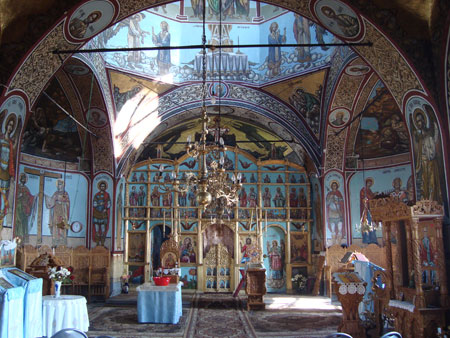
The Light from Above
I am an Orthodox Christian. And I am proud of it. In fact, we should justify our Orthodoxy (to ourselves only) in order to justify our intrinsic pride. By confessing our pride and belonging, we can explain our faith and our choice to remain in Orthodoxy.
Is Orthodoxy different from Catholicism? Certainly. But there are thousands of texts here that are much more informed than the one I could write. Is Orthodoxy the better path? Here we have to argue whether the answer is Yes. And I think it is.
A major difference that I feel is related to Orthodoxy is its openness. to man. Her promise to help man find his Father again, find his purpose again and reconcile with Creation. The desire of Orthodoxy is to be for man, in the Church but also outside it. Orthodoxy did not take God prisoner, did not lock him up in a building, did not confine him to a formal framework and does not affirm the necessity of mediation of the relationship with God by the clergy ( to reread The Grand Inquisitor's Speech– Dostoevsky). The Orthodox Church is gentle and modest. It has found its calm and dignified path in the quiet of reconciliation with fate, with destiny, with the Godhead that it does not claim to fully understand ( „"„"Thy ways are incomprehensible, O Lord."”) or controls. The Orthodox Church awaits and proclaims a revelation that will come from Above. It is the light that, in Orthodox churches, descends from heaven to the praying being. It is the light that, from Above, descends like an embrace to the one who has entered to find his peace. The light descends, unfiltered, simple, and gives us the lesson of expectation and faith: Forgiveness, Godliness, Salvation, will descend from above, from Heaven, to the believer.
The light in Catholic churches is filtered. It is modified by the stained glass that tells a story. A story written in glass by the one who built the place. It is a mediation, it is a story that you have to see, to understand rationally. The light does not descend, it enter filtered, colored, reading a story written by a man.
The Catholic Church stretches its arms upwards towards the Godhead. The Gothic arch, the battlements and its entire construction seem to ascend from the earthly to Heaven. It asks, it ascends, the ascendance is evident. It is an effort to rise, like arms that ascend towards Heaven, praying or begging for mercy. Is it you? the one who must climb, like the broken arch, trying to reach Heaven. None of the Orthodox modesty that, in simple prayer, receives the ray of white light from the ceiling. There is an immense modesty, a humility before the Creator, a sensitivity, a silence that is found in this white light, unfiltered, unmediated, of glorious simplicity. You cannot you access Heaven. The Ascension is not within your exclusive possibility. Salvation comes from Heaven and not from your ascendancy. Your ascendancy, carried out daily, is silent and has as its absolute value the expectation. Humility. You do not climb to Salvation alone. You do what you must or what you want to do and the Light will pour (or not) upon you.
There is a lesson here about the Romanian people. The one who, so many times, has been accused of passivity. It is our intimate belief that salvation is done quietly, in everyday life, in gestures that should not be shown, in the modesty of the deed done but hidden. It is the belief that everything we do is, was and will be Judged with justice ( ” You know all the threads in my head„"). It is humility before the Godhead to whom you cannot call to account or throw your good deeds in front of Him. There is no pleading. There is faith in the righteous judgment of the last day. It is not passivity, it is an incredibly strong Faith.
The difference in direction has generated, over thousands of years of history, differences in attitudes: for us the light descends, for them the archway ascends. We are calm in the light that envelops us, they are proactive in their climb towards the Ideal. Our calm as a resignation to fate ( the mioritic myth) is a profound acceptance of the power of God and the nothingness of man. It is an incredibly strong Faith in transsubstanceTial, in omnipotentță and fair trial. And I believe this force is superior to Catholic or Protestant pro-activity.
The Orthodox Church is open to people and to the world. This openness is also seen in painting. The Orthodox Church is painted and outside. On the outer walls. Its beauty is shared with the world without asking, without forcing the believer to enter it. It pours out and preaches and passers-by, not just those who enter. The Catholic Church is strict: you have to enter and find the painting, the advice, the beauty within it. Outside, gargoyles stare at you, cold stone stares at you, monsters and devils force you to enter, to seek refuge in the sanctuary of the sacred space. Because only within her is salvation and she possesses it almost exclusively. Only she can mediate the relationship with the Father in a controlled and sometimes (e.g. preaching in Latin) impossible to achieve without her help. There is an exclusivism, a trace of infatuation and restriction here. But that is my opinion.
Look at Orthodox churches: the beauty of the exterior paintings shares the mystery with the passerby, delights the eye and urges the calm and tranquility of the Divine presence. It does not force entry into the place. It opens its advice and story to everyone. It harmonizes with the natural world, with the ambient setting and rejects the hidden, the esoteric, the mediated. It opens outward without asking for anything. It offers itself to the viewer without putting obstacles.
The grandeur of Gothic Catholic churches is undeniable. But I can't appreciate this construction. humană at the expense of the small wooden church, in a forgotten village in the heart of the mountains. There is a difference between the strength of man who tries to reach the sky and the reconciliation of the one who enters to prostrate himself before God, kneeling, humble, between the daily struggle to do a good deed and the acceptance of everything that happens "by the will of the Lord.".
Two divergent positions, revealing two attitudes towards life and death, towards the relationship with God.
Perhaps for some (maybe many) the pro-activity of the Catholic Church is closer, more natural. But for Romanians, Orthodoxy has been etched in their blood for thousands of years and I don't think anything can erase it. By accepting who we are, we find liberation in our own peace. Catholics, the West, however, imposed its own vision on the modern secular world ( just do it, keep walking, yes we can) and created the universally accepted social model. Even modern atheism seems to be born from opposition to Western dogma. But we are not like that. Hence, perhaps, this alienation of Romanians in the face of modern history.
I cannot accept that this path, already imposed (and accepted) on the contemporary world, is the only measure of things. It is the measure of civilization. western. But we are different. Until we accept this, until we rebuild our way of judging ourselves, of rebuilding our inter-human relationships from the perspective of our soul model („"the matrix is notment"ah"”), we will remain strangers, maladjusted and unnatural in the modern world. What we might understand is that we are not like that at all: we are just different. Intimate. We are Orthodox people.
Tribute to Lucian Blaga