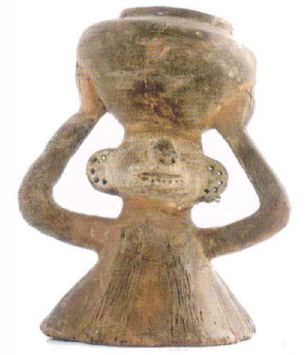
Statuette with a bowl on its head. Gumelnita Culture
Gumelnița culture.
In this essay I will focus my attention
on a statuette belonging to the Gumelnița culture, "Statuette with a vessel on its head".
The piece was discoveredă îin 1963 în
the area of the Măgura Gumelnița archaeological site and is only in the history of the European Neo-Aneolithic.
The Gumelnița culture is in a cone of
shadingă undeserved.
It is (along with the Ariușd-Cucuteni-Tripolie cultures) one of the most
remarkable civilizations of the second half of the 5th millennium BC. The name
culture first appearsă in 1922 within the creator's writings
șRomanian archaeological schools,
prof. Vasile Pârvan but the name that will consecrate thisă growingă șand who will put all his energy into her service is the teacher
Vladimir Dumitrescu whose works are still relevant for
historical researchă.
Culture
Gumelnița in Romania overlaps with that of the Boian culture in Wallachia, and research
and modern evidence shows usă its expansion into the Dobrogea area
(see șand "Gumelnița Culture"
in Northern Dobrogea" - Cristian Micu), southern Bessarabia, the eastern partă of Bulgaria, reachingă to the Aegean Sea. But „we find that the center of the region on
which proves to have existed the Gumelnița civilization – but of course not the center
geometric, but the spiritual center, if we may say so, was undoubtedly the Danube
lower, from the east of the Olt and close to the mouth."(course from the year
1930- Professor Vladimir Dumitrescu- University of Bucharest).
Culture
Gumelnița has its own intrinsic specificities. Some are easy to identify and
documented (we avoid saying "well documented" because the entire Gumelnița culture
is incredibly poorly researched îdespite sufficient archaeological materials) such as settlements of the type tell STATIONS îaround some
natural resources necessary for the prosperity of the settlement, îin the vicinity
watercourses suitable for agricultural activities, animal husbandry, hunting
and fishing. The settlements are also located îin easy-to-reach areas
defended (terraces, islands, isthmuses) later reinforced (or not) with systems
created by the defense.
Piece îin discussion
appears well documented îIn the first (and only) catalog of Eneolithic sculpture (at that time period
from the "Oltenița District Museum"), plate V.
The statuette with the bowl on its head is almost complete
and has a height of 22.5 cm. The dating places it îaround the years
4.400-3.950 îB.C. The piece of
suffered a strong burning after creation, thus being deformed and cracked.
The piece has two sides, the head (somewhat exaggerated compared to the rest of the body)
indicating a duality of a representation, a duality noted in several
artifacts of the same culture discovered at the same site. The two faces have
strongly highlighted noses, clearly defined nostrils and the mouth suggested by a
horizontal line with dimples. The eyes are not drawn but, upon close examination
Two depressions are visible in the eye areas. The ears are pierced by five holes
(?). The neck continues with a cloche-type dress through which the breasts protrude outwards. This dress is decorated with fascia
straight lines, delimited by white stripes, and was colored with red-ochre. In fact, it is
notice the existence and use of white (arms, dress, face) possibly
thus stating that the entire statuette was originally painted. The bottom of the
the statuette did not suffer the same secondary burning that deformed the
superior and gives us indications of its overall image, before deterioration.
Sculpture is difficult to integrate into
the series of those expressing a (matriarchal) divinity or mystical-magical statuettes.
Representations of this kind are numerous and easy to identify. To
Unlike these, the "Statue with a Vase on its Head" seems like a work of art, created
to delight the eye, bring pleasure and define a recognizable activity.
The stylization is not in the area of abstraction, we have no attempt at rendering
faithful to reality, we have a pleasant sculpture, meant to delight, to give substance
existence, life, immediate reality denoting a peaceful life of the community members.
Art object probably supporting fire, opal meant to bring light into the room and
in the soul of the viewer.
The objects of the Gumelnița culture (and not
only them) would deserve an interdisciplinary research because, where archaeologists
I don't see the beauty or utility, visual artists or psychologists might
easily identify the importance of these 6000-year-old sculptures
years. Further interdisciplinary research could highlight and shed light
on the degree of "development" of some prehistoric civilizations through their very existence
„"art objects" and Art.
Bibliography:
1. Sculpture catalog
Eneolithic artifacts from the Oltenița District Museum, Silvia Marinescu-Bilcu and Barbu Ionescu
2. The man in
Neolithic statuettes from RPR, Vladimir Dumitrescu 1961
3. Meaning
and the origin of a type of female figurine discovered at Rasl 1957, Vladimir Dumitrescu,
4. plastic
anthropomorphic and zoomorphic Gumelnița, Radian Romus Andreescu
5. Anthropomorphic figurines from the Neolithic era, E. Comșa, 1995, Bucharest.
6. extract
from a course held in the 1930s at the University of Bucharest, by
Professor, Associate Professor Vladimir Dumitrescu