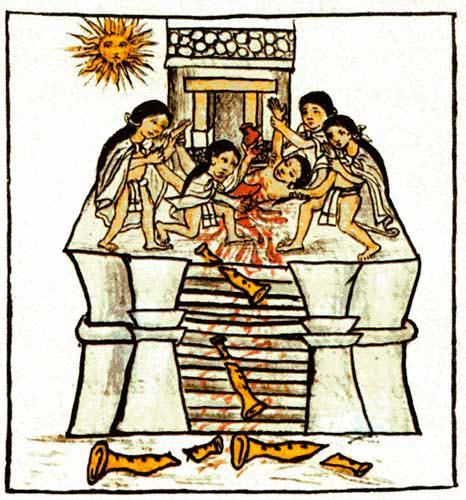
The human sacrifices of the Aztecs.
„[…] Brought to the stump, which was a stone three palms long
and still a little in height and almost two in width, they were turned over on their backs
and held by five people: two held their legs, two held their arms, and
one head. Then the priest who was supposed to kill them would come and hit them in the chest with
both hands with a flint stone, crafted like a spearhead, and,
through the operated opening, he would put his hand in and rip out the heart, then offer it to the sun
and threw it into a gourd. Once the heart was torn out and the blood thrown into a gourd,
taken by the master of the prisoner or slave who had died, the body was thrown
and rolled down the steps to the base of the temple. […]”
Bernardino de Sahagun (Franciscan missionary), (1499-1590)
„"Historia general de las cosas de Nueva Espana" Tomo II
„[…] On that stone the wretch was lying on his back
to be sacrificed, with his chest very stretched, because they kept him tied by his hands
and legs […] as the poor man's chest was so stretched, they opened it with
much power, with the help of a cruel knife and quickly tore out the heart, and the
who officiated the abject act would strike his heart against the outer side of the altar threshold,
leaving a bloodstain there […]”
Toribio de Benavente Motolinia (Franciscan missionary), (1482-1568)
„"Historia de los indios de la Nueva Espana"”
„ […] The nations that offered human sacrifices
their gods, they thus showed, as the lost idolaters they were, the lofty idea they
who nurtured it about the excellence of divinity, about the value of their gods and how
how noble, how high was their veneration of the divinity. Therefore, they
prove that they possess, to a greater extent than other nations, natural reflection,
the justice of the word and rational judgment. And in matters of religiosity, they
were above all other nations, as the most
religious communities in the world are those which, for the good of their peoples, offer themselves as
sacrifice their own children. […]”
Bartolomé de las Casas (Dominican missionary), (1474–1566)
„"Brevísima relación de la destrucción de las Indias"”
„ […] The Indian took his small load of gifts
for the knights of the sun, the staff and the shield and began to climb step by step
towards the top of the temple, which embodied the path of the sun from east to west.
When he reached the top and stood in the center of the great sunstone, which was
there to indicate sunset, the sacrificers would arrive and sacrifice him,
opening his chest in the middle. His heart was taken out and offered to the sun,
throwing the blood towards the star. Then, to represent the descent of the sun
to the west, they let the body roll to the bottom of the stairs. […] „
Diego Durán (Dominican missionary), (1537–1588)
„"Historia de las Indias de Nueva Espana e islas de Tierra firme"”
The subject is one that is much commented on and much "tasted" by the curious,
by friends, researchers, thrill seekers or the film industry.
All these emotions led to a clear distortion of the procession, of motivation,
but also to a wrong judgment of this ritual viewed eminently from a perspective
Catholic-Spanish. In fact, following the first reports, a
massive wave of condemnation of the "criminal emperor" Moctezuma, apparent outrage
intended to hide and justify the looting and genocide committed by Spanish troops.
Subsequently, many historians began to challenge these practices and catalog
these accounts as "propaganda." Unfortunately for them, the archaeological evidence
Recent evidence, however, shows that these rituals were neither isolated nor small or
large scale.
The descriptions of the conquistadors (Hernan Cortes, Andres de
Tapia etc.), but also the later ones (such as those of the clerics Bernardino de
Sahagun, Toribio de Benavente Motolinia, Bartolomé de las Casas or Diego Durán
) describe with sufficient accuracy the ritual of human sacrifices of the empire
Aztec, with slight differences. Sacrificed (according to DNA studies – prisoners of war
or slaves not belonging to the Aztec population by ethnicity) was brought to the top
of the pyramid, in the area of the sacrificial stone, where he was nailed by 4 or 5
people (women or men) while the priest opens their rib cage
with a flint (or obsidian) knife. Once the rib cage was open, the priest
he put his hand into the cavity and took out the heart of the sacrificed one, showed it/pointed it/offered it
the sun god and then throws it into a vessel belonging to the slave's master or
prisoner of war. His body was then pushed down the steps of the pyramid,
allegorically reconstructing the sunset.
The four descriptions analyzed seem to be grouped in pairs:
the first two (Bernardino de Sahagun and Toribio de Benavente Motolinia) are
inflamed and firebrand, disregarding cultural differences and
religious relations between the viewer and the participants in the ritual or its meaning
for them. The following (Bartolomé de las Casas and Diego Durán) are however
more reserved, seeking to understand religious practices, ethical-moral values
or the idea of justice or Law of the Aztec population.
The revulsion and indignation of the first two descriptions seem to
be generated by the "voluntary" forgetting of the (known) history of Roman practices,
Egyptian or Chinese (the latter still unknown to the conquistadors)
(Spanish). Drawing a parallel we can say that it is difficult to be terrified of
„the "massacres" of Aztec sacrifices (reported around the 1500s), where we find almost
700 human fragments (Templo Mayor) when, in the same period (August 23-24
1572), in Paris, about 30,000 Huguenots were massacred (Saint
Bartholomew).
Aztec human sacrifices were real and had their
have their origin in the religious and traditional beliefs of these peoples
united under the Aztec Empire. Ritual is important for the cohesion of a people
and is never arbitrary or of no major importance in the functioning
and the existence of that state. Looking at it equidistantly, from my point of view, the ritual
sacrificial is a minor aspect, lacking significant importance in understanding
Aztec society, a fact also revealed from reading the "Códice Tudela" located in the Museo
de América where the plates representing these practices are few and
the descriptions are much calmer.