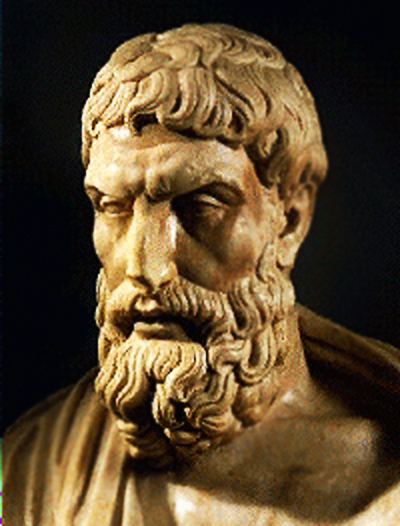
Late clarification. Epicurean manifesto.
For 2000 years, the Epicureans and hedonists were banned, their works destroyed and attempts were made to erase them from the history of philosophical thought. The idealists never stopped for a second from taking their thoughts and actions to extremes, the extreme being intrinsic to monotheistic or atheistic idealism. Probably the most constant accusation is that of promoting "pleasures" and corrupting "the young". A strange accusation brought against the Epicureans, since it was the one that condemned to death the one who laid the foundation stone of Platonic (and then Christian) idealism: Socrates. However, to clarify this 2000-year-old problem, let us listen to Epicurus and judge the accusations for ourselves:
„"Let us think better that some desires are natural, and others groundless: of the natural ones, some are necessary, others only natural. Of the necessary ones, some bring us happiness, others are beneficial to the body, and others to everyday life.
A thorough knowledge of these things can relate any preference and aversion to ensuring the health of the body and spiritual peace. This is in fact the goal of a happy life. Indeed, through all our actions we aim to be free from suffering and fear. Having achieved this goal, the storm of the soul is calmed, and the person concerned no longer needs to pursue what he lacks, nor to seek anything else through which to acquire the happiness of body and soul. We feel the need for pleasure in its absence, or when pain comes. But, when pain does not appear, we no longer feel the need for pleasure. Therefore, we call Pleasure is the beginning and goal of a happy life.
Therefore we find that pleasure is our first good, which is proper to us. We take it as the starting point of every preference and every aversion, and we return to it in evaluating every good with the help of our affections, taken as criteria. Since pleasure is the first of the innate goods, we should not choose every kind of pleasure, but often give up many, when from them a greater displeasure arises for us. Often we consider some sufferings preferable to pleasuresr, if the long endurance of some torments ultimately brings increased pleasure. Therefore, not every kind of pleasure is to be chosen, just as not all or every suffering is an evil. Therefore, Not all suffering should always be avoided.
All these things must be judged with moderation, comparing them with each other and taking into account the advantages and disadvantages. In certain circumstances, we treat good as evil, and, conversely, evil as good. In the same way, we consider independence from external things as a great good, not only so that we may be content with a little, in all circumstances, but so that we may be content with a little, if we have no more.
It is good to be fully convinced that abundance is enjoyed by those who need it least. As Everything that is natural is easily obtained, and only that which lacks real value is difficult to obtain.. A simple meal brings us as much pleasure as an expensive one once the suffering of lack of food has been removed. Bread and water give the highest possible satisfaction if they are given to the one who lacks them.
That's why, getting used to simple and cheap food fulfills everything necessary for health, enables a person to cope with the necessities of life without difficulty, disposes him when he sometimes finds himself in front of a rich meal, and makes him no longer fear the blows of fate.
When we say that pleasure is the purpose of life, we do not understand the pleasures of the wicked, nor those that consist of sensual delights, as some think, or of ignorance, incompetence, or misunderstanding. By pleasure we mean the absence of suffering in the body and disturbance of the soul. Not the uninterrupted necessity of feasts and orgies, not sensual love with boys and women, not the delight in a good fish or other delicacies of a rich meal, makes life pleasant, but sober judgment, the search for the reasons for each option or rejection, as well as the banishment of those opinions through which the greatest disturbances take hold of the soul. Of all these, the first and best is wisdom. Therefore, wisdom is a a thing more precious even than philosophy; from it spring all the other virtues, for it teaches us that we cannot lead a contented life unless it is also wise, decent, and just; nor can we lead a wise, decent, and just life that is not a pleasant life, because virtues go hand in hand with pleasure, and a pleasant life cannot be separated from virtues. "„