Legacy that I forgot about...
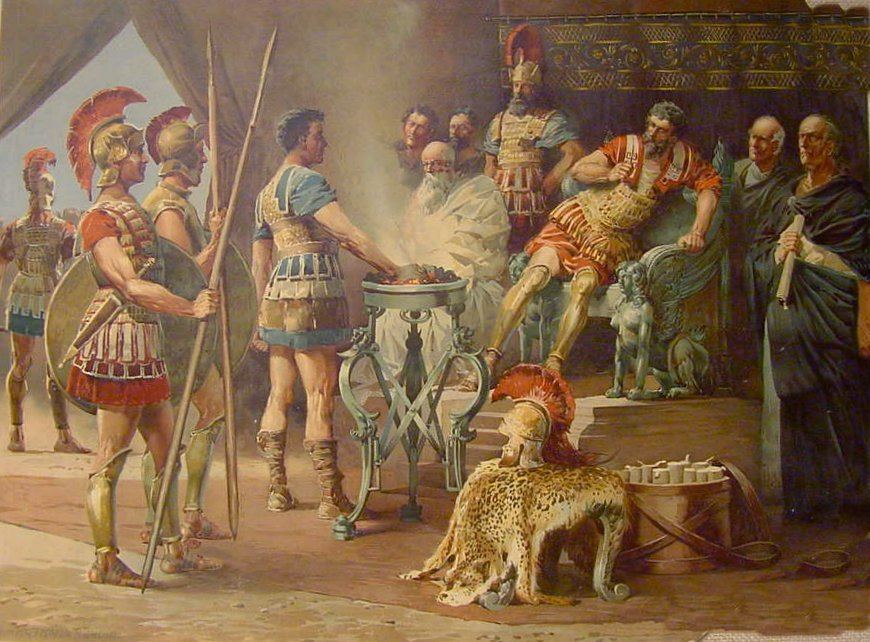
In Letters to Lucilius, Seneca repeatedly refers to the example given by Mucius Scaevola. Being convinced that few people know his story, I return to it. Stoicism was and can become a reality again, being intrinsic to European culture. Sacrifice not based on an amalgam of religious beliefs, hysteria and indoctrination but based on moral, philosophical principles and in defense of freedom. The latent power of the peoples of Europe exceeds the imagination of its enemies. Do not wake the sleeping monster….
Gaius Mucius Scaevola (b.?-d. 509 BC) was a legendary heroic figure of Ancient Rome.
When the Etruscan king Porsenna besieged the city of Rome, Gaius Mucius, on
his real name, managed to sneak in armed, during the night,
in the Etruscan camp, planning to kill King Porsenna. The attempt
failed because Mucius killed another man in Porsena's place.
Captured, he was taken bound before the Etruscan king. Full of pride,
Mucius was about to perform a feat that astonished the entire ancient world. Standing
righteous and fearless, Mucius looked Porsenna in the eye and declared:
„"I am Gaius Mucius, a free citizen of Rome. I have come here, as an enemy,
to kill my enemy. I am ready to die just as I am ready to kill. At
like me, three hundred other Romans swore. Before I die, I want to
I punish my hand that failed to kill you, King Porsenna.” In
In front of the astonished Etruscans, Mucius placed his right hand on a burning torch
and stood there motionless, showing no sign of pain as he
his hand would sizzle, smoke, blister, and change color
under the action of the merciless flames. The incredible novel thus held its
hand until it turned into a grotesque, smoking black stump.
Impressed by the young man's courage, King Porsenna released him. Because
left with his right hand mutilated for life, Mucius was nicknamed
Scaevola (left-handed). – wikipedia-