And yet History explains
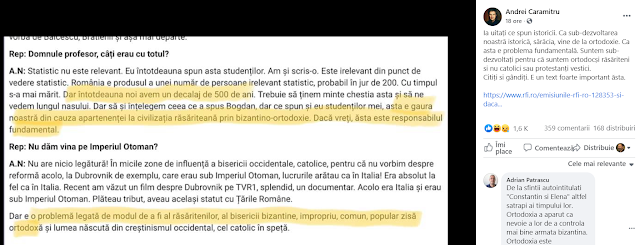
The man in the marketă typeă, I shoută, make a fussăbut lives from it. He is the seller of hysteria and, withâThe more empty t is, the more resonant it is.ă bigger thanhen finds its appropriate "audience" (after all, the biggest noise is made by a cartă with empty barrels, not the one carrying the barrels full) . The man in the marketă merită ignored thatăbut to comment, to respond means toă you're playing his game. It's what Americans call "enabling an idiot." And ifă you didn't realize, it's about the embarrassing Andrei Caramitru. Whom we managed toă I ignore him.ână now without problems. And I will continue toă I do it when I can. In this case, however, he showed me another fallen character. îin a graveă error, which he promotes from the height of a history professor. It is Mr. Adrian Niculescu. No, it did not catch my attention până now through his writings (which is why we will not comment on his historical writings) but through a few statements, erroneous from the point of view of history, made during a radio broadcast (RFI).
You can find the show here: https://www.rfi.ro/emişinile-rfi-ro-128353-si-daca-totusi-am-traversat-cei-mai-buni-30-de-ani-din-istoria-romaniei
In short, in a few lines, Professor Adrian Niculescu supports theses according to which the Roma peopleân is "backward" because of faith Orthodox a and not the geo-political conditions of the medieval periodă. Found out îin a graveă error, the much-too-badly-informed Adrian Niculescu statesă că the rest would have had the same conditions țăcountries subjugated to the Ottoman Empire, therefore, through an erroneousă logical deductionă, belonging to Orthodoxy would have "wretched" us. The implicitly suggested solutionă is the transition to Catholicism, a supported solutionă in several rows and the embarrassing bugleă of hysterical neo-Marxism.
The thesis is erroneous.ă, as demonstrated by a study conducted by Professor Bogdan Murgescu, professor at the Faculty of History of the University of Bucharest and, since 2011, president of the Romanian Society of Historical Sciences, after serving as vice-president between 1999 and 2011. His Excellency presentsă simple serious situationă where they were found TăRomanian countries in the mentioned periodă by "this" Adrian Niculescu:
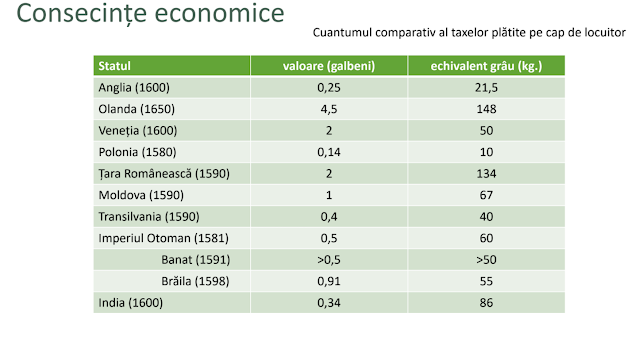
According to the calculations made by the diligent and the discreet historian Damaschin Mioc, in order to procure the necessary amount for the payment of the tribute, each household had to to sell in 1594 a horse, an ox, 2 bushels (75 l) of wheat, 5 sheep and 3 jaws (4.5 ha) of agricultural land.
The obvious conclusions of the data presented above are drawn by Mr. Lect. Univ. Dr. Radu Nedici as follows:
– The increase in monetary obligations pushed many peasants to go into debt, and later to sell their land and sell themselves as Romanians or neighbors. D. Chirot estimates that half of the villages of Wallachia, especially those in the plains, were in this situation.
– The ruin of the free peasantry favored the boyars, who emerged as the main buyer of the lands and people who fell into serfdom. This social polarization is unfavorable in the long term for the central power, which sees itself without a political partner to oppose the boyars.
– The tribute of the two Romanian Principalities increased several times during the decades from the middle of the 16th century. In the case of Wallachia, it started from 12-15,000 galbens in the first decades of the century, reached 20,000 galbens by 1540, 50,000 in 1545, reached 104,000 in 1574, stabilizing around 84,000 in the last part of the century. For Moldavia, the starting point was 8-10,000 galbens at the beginning of the century, increasing to 15,000 in 1541, 40,000 in 1568, 53,000 in 1574, to reach the maximum of 66,000 galbens in 1583, after which it decreased due to the devaluation of the Ottoman harsh. For comparison, Transylvania's tribute amounted to 10,000 gold coins until 1575 and 15,000 gold coins after that year.
– However, the tribute represented only a part of the payment obligations to the Ottoman Empire. These also included the official protocol gifts offered to the sultans and great rulers (peșches), as well as the amounts offered as bribes for the purchase of the throne and confirmation in the reign (rșvet). The total of these payments has been estimated for the 1580s at approximately 600-650,000 gold coins annually for Wallachia and 300,000 gold coins annually for Moldavia.
– The level of taxes and state indebtedness meant for the inhabitants of Moldova that they were placed at the upper level of European averages, while in Wallachia the economic burden of Ottoman domination rose far above the highest figures on the continent.
– According to B. Murgescu's estimates, in 1594 an inhabitant of Wallachia had to pay a tax of 3 gold coins (0.3 gold coins in France, 1 gold coin in the Mediterranean world, 0.5 gold coins in the Ottoman Empire); the value of exports amounted to 1.5 gold coins / capita (0.5 gold coins in Poland, 1 gold coin in France, 1.6 gold coins in Castile); the amount of debts amounted to 10-19 gold coins / capita (2.5 gold coins in Moldova, 5.5 gold coins in France and Spain).
– High taxation led to the forced commercialization of goods through exports to the Ottoman market. The revenues thus generated returned to the Ottomans in the form of various taxes, which blocked domestic investments and eroded the motivation of producers. Despite the appearance of modernity (barter economy, speed of monetary circulation), this economic reality meant the integration of the Romanian space on the periphery of the Ottoman economic world.
– At a first level, Ottoman domination was equivalent to political instability: in the second half of the 16th century, 17 rulers succeeded to the throne of Wallachia, and 21 to that of Moldavia.
– Financial pressure was responsible for the impoverishment of entire social categories and the massive export of raw materials. At the same time, it forced the reign to increase the means of control over people and space, bringing the beginnings of a process of state centralization that had been lacking in the Middle Ages.
– The integration of the Romanian Countries into the Ottoman economy-universe led to the orientation towards the same market of the two extra-Carpathian principalities, which ceased to be competitors. These are the timid beginnings of economic unification, after in the Middle Ages the Polish and Hungarian trade routes had determined divergent options.
But no, the data is irrelevant (or unknown) for Mr. Adrian Niculescu who draws his conclusion, from his own ignorance: Orthodoxy.
When hatred is great, even History no longer matters.