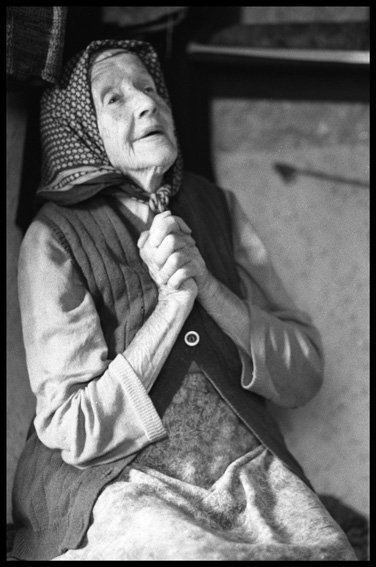
Words from a fallen people. The ultimate tearing apart.
„"Lord, Lord, I say Lord a lot.".
God seems to be sleeping.
With my head on a monastery
"And no one knows about it."”
A superb exploration into the meanings of this quatrain was written by Mr. Ion Talos. Since I have nothing to add, I reproduce his work below.
„"Philologica Jassyensia", Year IX, No. 2 (18), 2013, pp. 195–207
Poetry and philosophy in a folkloric quatrain selected by L. Blaga: Lord, Lord…
Ion TALOS
The anthology of folk poetry opens with the following disturbing quatrain: "Lord, Lord, I say much, Lord./ God seems to be sleeping/ With his head on a monastery/ And no one knows about him.".
It was taken from Ion Pillat's brochure, Songs from the People (Bucharest 1928), where it bears the title: Doamne, Doamne, with the mention: From Transylvania.
We know today the importance this text had in the poet's eyes, among other things, because Ion Muşlea, who stood by him during the compilation of the anthology, suggesting to him most of the sources from which he would select, left us some particularly valuable notes. These refer not only to the conception and working method adopted by Blaga, but also to the above text (cf. Taloş 2013: 70–81). Muşlea also reproduces a conversation he had with the poet regarding this quatrain. The poet referred to a text of the North American Indians, entitled Cântecul stelelor, which he had selected for his beautiful anthology of universal lyric, saying:
– We don't have anything like that, said Blaga.
Muşlea reacted:
– Yes, two or three texts: Miorița for example.
Blaga replied:
– Mioriţa? No!… Others, for example: „Lord, Lord,/ I say Lord a lot./ God seems to be sleeping,/ With his head on a monastery/ And he has no knowledge of the world.” What abysses! – the poet concluded.
It may come as a surprise that, in his conversation with Muşlea, Blaga valued this text more than Mioriţa, that is, the ballad that served to build his philosophical system. This is one of the reasons why we should pay special attention to this quatrain.
1. Bern: Lord, Lord versus Stundenbuch, by Rainer Maria Rilke
Among the first cultural activities carried out as press attaché of the Romanian Legation in the Swiss capital, Blaga compiled an Anthology of Romanian Folk Poetry (1930), which he translated into German together with Hermann Hauswirth. Her texts, including the above quatrain, were recited by the latter at cultural events organized in the major Swiss cities of Bern, Basel and Zurich. It seems that she had the greatest success at the Ethnographic Society of Switzerland, which dedicated its annual meeting in 1930, in Bern, to Romanian folk poetry. In addition to the members of the society, there were also academics such as Karl Jaberg, writers such as Hugo Marti, journalists, etc.
We first learn about the success of this text from the article Mioriţa in Elveţia (in „Drumul nou”, 1, 1931, no. 13, p. 1–2, apud Blaga 1973: 160), signed by Lucian Blaga. As Blaga writes, Doamne, Doamne provoked the intervention of the Swiss writer Hugo Marti, who claimed that „Rilke, the great German poet, has somewhere in the Stundenbuch (or elsewhere) a similar image. Or it is known, says Mr. Marti, that Rilke lived in a Russian village at the time he wrote the Stundenbuch. Did he not hear poetry similar to the Romanian one in those places?”.
Marti's suggestion raises two questions: 1. whether the motif of God's sleep appears in Rilke's poetry and 2. whether this motif appears in Russian folk poetry. I found it rather curious that Blaga, who appreciated Rainer Maria Rilke's poetry so much, did not try to verify what Hugo Marti suggested. And I also did not understand why the latter did not himself search the German poet's work for the correspondence of the Romanian verses in question. But perhaps it seemed to both of them too insignificant a matter to undertake such research. It could also be imagined that Marti's suggestion was due to a momentary impression, given that many see in Rilke's volume of verses the expression of a pantheistic God.
I found it useful to take up Marti's suggestion, looking for the image in the volume of verses Stundenbuch (Rilke 1918)4. I first noticed that, indeed, God is present in almost every Rilkean poem, but I found only fragments of the image I was looking for; for example: in Rilke's poems there is often talk of churches and monasteries (pp. 28, 33, 54, 67, 70), there is talk of Schweigsamkeit (pp. 33, 39, 42, 53), silence, and of Einsamkeit (p. 80), the solitude of God. In several places, Rilke addresses serious questions to God: "don't you hear how I bump into you with all my thoughts?" („Hörst du mich nicht mit allen meinen Sinnen an dir branden?”, p. 16) or: „do you hear the blind steps of those who wake up at night and seek you, treading the darkness?” („Hörst du sie mit dem Schritt von Blinden/ das Dunkel treten?”, p. 55) or: „who, I wonder, lives life, do you, Lord?” („Wer lebt es denn? Lebst du es Gott, – das Leben?”, p. 62). The German poet asks God, after creation, to rest his hand on the edge of the sky and to suffer silently (mut) what we humans do to him: „Laß deine Hand am Hang der Himmel ruhn/ und dulde stumm, was wir dir dunkel tun” (p. 20). But the poet’s message reaches God only through the wind: „du hörst mich wieder durch den Wind” (p. 52).
Finally, the image that we can assume that Marti had in his memory is the following: God is in every house, more precisely, he sleeps on every hearth („auf allen Öfen schläfst du breit”), and further on, in the same poem: „you are the peasant with the beard, from eternity to eternity” („Du bist der Bauer mit dem Barte/ von Ewigkeit zu Ewigkeit”, p. 27). Without being identical, the image in Rilke’s work (God sleeps on every hearth) and the one in Romanian folklore (God sleeps with his head on the monastery) are in any case very similar.
Therefore, Hugo Marti's suggestion was not without interest. It probably started from the general idea that, in Rilke's poetry, man addresses God, without receiving an answer, as in the Romanian folk quatrain. To summarize, we can say that reading Rilke's volume mediates the discovery of several elements common to the folkloric text and the texts of the German poet. These are: the question of whether God hears the poet and whether he hears the blind steps of those who seek him in the darkness; then: the silence, solitude and even the sleep of God, as well as the frequency of the terms churches and monasteries.
I would like to add here that, in Romanian folklore, the motif of God's sleep also appears in the legends about the "Creation of the World": God sent the devil to bring "seed of earth" from the bottom of the primordial sea, he fails twice and brings, the third time, only a few pieces of earth, under his claws. From this "seed" God creates the earth, the size of a bed, on which he lies down and falls asleep. Believing that the time has come to escape from God's presence on earth, the devil rolls it east, then west, north and south, in the hope that it will fall from the earth into the sea, but the earth stretches out in all four directions. Without knowing it, the devil rolled God in the shape of a cross, which constituted the "sanctification" of God's creation5. Referring to this motif, M. Eliade speaks of "God's fatigue" following creation and compares the motif with that called, in primitive religions, deus otiosus (Eliade 1980: 98).
I return to the second question suggested by Marti, namely whether the image in the Romanian text (God sleeping with his head on a monastery) is known in Russian folklore; a definite answer could only be given by a specialist in Russian folk lyrics. Personally, I can only say that it is not found in the comparative folklore materials that I have managed to consult.
Marti's suggestion seems extraordinary to me from another point of view, namely: indirectly, the Swiss writer associates a Romanian folklore piece with the poetry of the great Rainer Maria Rilke. Indeed, after reading his volume, it seems to me that the Romanian folk poet was no less inferior, in terms of his vision of the relationship between man and God, than the German author. Moreover, our text could have found its rightful place among his creations or, in other words, if we had found it in the Stundenbuch, our text would not have made a discordant note compared to Rilke's poems.
The above, however, raises a new question: how can the presence, in a similar form, of the image in question in Rilke and in Romanian folklore be explained? The explanation certainly does not lie in the phenomenon of acculturation, as Marti seemed to suggest, that is, the image of God sleeping on the hearth does not come from Rilke's Romanian text (most likely not from any Russian one); on the other hand, the Romanian folk creator was not influenced by the work of the German poet either. However, it could be assumed that in the case of both the Romanian folk creator and Rilke we are dealing with a universal cultural asset, which probably comes from a verse of the Song of Songs (5.2) or from its adaptations, a verse that reads as follows: "I sleep, but my heart watches.".
This verse also explains the profound meaning of the magnificent Romanian text: God is present among men, his heart watches, but, since he is silent, it seems that he is sleeping. I emphasize that in the folkloric text God's sleep is only apparent, that is, this is the perception of man, in moments of despair. With a Transylvanian expression, you think God is sleeping, an image suggested by the idea that God does not intervene in the course of things, as man would like.
The connection of our quatrain with the Holy Scripture is beyond doubt. In the Old and New Testaments we find the word Lord 481 times. Even the opening formula, „Lord, Lord,” appears many times in the Old (Book of Esther 4.17; Psalms 129.3; 139.7; 140.8) and in the New Testament. I will take some examples from the New Testament:
And why do you call me, Lord, Lord, and do not do what I say (Luke 6:46);
Not everyone who says to me, Lord, Lord, will enter the kingdom of heaven, but he who does the will of my Father who is in heaven (Matthew 7:21);
Many will say to me on that day: Lord, Lord, have I not commanded in your name, and have I not cast out demons in your name… (Matthew 7:22);
…the other virgins also came, saying, Lord, Lord, open to us (Matthew 25:11).
2. Was Blaga found in this quatrain?
As we have seen, the present quatrain was in Blaga's attention starting around 1930. During the period of the elaboration of the anthology of popular lyrics (1950–1960), the text probably had a more accentuated personal connotation, since the establishment of the communist regime in Romania deprived the poet of everything he had acquired through assiduous work: the title of academician and that of university professor, and he was forced to take a position as a documentarian at the Department of Literary History and Folklore of the Institute of Linguistics of the Cluj Branch of the Academy. For that period, the text seems to be the poet's cry of despair, addressed to God, who was late in putting things back on track, remedying his situation. But Blaga was not thinking only about his situation. In the aforementioned conversation with Ion Muşlea, the last verse of the popular song spoken by Blaga sounded, as in another possible oral version, as follows:
„"And he has no knowledge of the world,",
proof that Blaga suffered because God did not intervene in the destiny of the Romanian people, leaving the impression that "he was sleeping".
The image in our quatrain expresses a situation similar to that in the famous expressionist canvas "Der Schrei" by the Norwegian Edvard Munch, in which man cries out his despair in an almost empty universe, a universe in which man is surrounded only by loneliness and indifference. I think that's how Blaga saw himself at that time.
On the other hand, the way Blaga interpreted the unusual image of "God's sleep" also raises the question of the philosopher's attitude towards the Christian religion, which brought him criticism from D. Stăniloaie (1942). Ovidiu Drimba, Professor Blaga's former assistant, shows that the above text was repeatedly the subject of comments in his courses. Drimba says:
[…] Blaga was not interested in the fact that he was not considered a Christian and Orthodox thinker! On the contrary: he declared himself a heterodox – showing at the same time that popular thought, the philosophy of our people, also includes clear strands of heterodoxy. I remember perfectly – Drimba continues – that, in this sense, he quoted a short popular poem that he considered an unsurpassed peak of philosophical thought and poetic beauty. [Drimba reproduces the text above and continues:] A true gem – but heterodox! – of our popular genius, included by Blaga in his incomparable anthology of popular poetry (Drimba 1995: 283).
3. The place of the quatrain in Blaga's system of philosophical thought
Blaga left us two quite different interpretations of the four verses: in the philosophical work Spațiul mioritic and in the novel Luntrea lui Caron.
In the Mioritic Space he interprets it as follows:
Man is not alone before God, who distances himself to the point of disinterest in the world (sometimes the Gothic towers seem like human arms that stretch out and no longer reach him), man is before a God full of protective initiatives, the world is a welcoming vessel, a receptacle. Even when the Orthodox man, tried in spaces of hardship by the blows of fate, seems to doubt divine care, he nevertheless does not doubt God's presence in the world. Divine absenteeism is attributed rather to other circumstances than to a distancing from the world (Blaga 1969: 172–173)6.
In the nineteenth chapter of the novel Caron's Boat (Blaga 1998: 533–535), Blaga inserts 11 "metaphysical fairy tales" - this is what he calls the philosophical essays -, which he writes are the notes taken by Ana during the discussions she had with Leonte, the twin of Axente Creangă alias Blaga. Consequently, he "edits" Leonte's metaphysics, selecting "from the history of metaphysics that the Romanian people could have thought of only those that seemed accessible to a vivid imagination". Leonte's "metaphysical inventions" "are imagined on the lines of a history that did not take place, but which could have taken place" (ibidem: 514). "And each responds in its own way to the human longing to anchor in the absolute" (ibidem: 515). Among these "metaphysical fabrications" is also included the text entitled Moral Luminism (ibid.: 533–535), a text that deals with some "heresies so strange and little understood"
6 One of Blaga's first interpreters, Vasile Băncilă, refers to this text, writing: "It is true that the peasant very rarely says this and more in jest, with a shade of mock humor, with a virile and approving gleam of resigned air, but there is no less in this an indication for some non-theological variations of the idea of God. One would think […] that God comes out low for the peasant. That would be the case for the intellectual, but for the peasant it is rather the other way around. In his perfection, God also has the freedom to 'make mistakes' or to do anything. […] God is perfect, he is powerful and basically everything he does, he does well, even if it is a 'mistake' for us. […] That is how the peasant thinks. […] He exalts God even the negative or what seems to us to be negative" (Băncilă 1995: 114).
in accordance with official church teaching", such as the quatrain under discussion here, in which "the state of sleep and disinterest in the world are attributed to the divinity. What strange implications a four-line folk poem can have!" - writes Blaga. The author believes that this text is not the only one in our popular literature, which "takes up official theology in many ways and at every step". Such is the legend according to which "in the beginning" the sky would have been very close to the earth, so close that you could have touched it with your hand if you had climbed a fence. However, it happened that man, in his wickedness and sinfulness, would have hit the sky with stones or would have soiled it with unspeakable filth. God would then have raised the sky, also distancing himself from this earthly world. God, conceived theologically as omnipresent, and especially everywhere present with his infinite grace, is imagined by the people in a more humane way. God was once very close to our world, but he later moved away, punishing with his disinterest the creature who did not understand to respect the sky as it fell (ibidem: 533)7.
The withdrawal and distancing of God from his own creation is a folkloric motif that M. Eliade also dealt with, who showed that "God withdraws into heaven because people have chosen evil and sin". God disassociates himself "from evil and sinful humanity", an idea that is not part of "Judeo-Christianity" (Eliade 1980: 98). Elsewhere, Eliade writes that "in Romanian religious folklore Christianity is not that of the church" and appreciates that in Southeastern Europe we find "a new religious creation", which he calls "cosmic Christianity" (ibidem: 246).
What led to the emergence of such an idea? Blaga writes:
Only a life experience full of disappointments, only serious moral bitterness can lead to the conviction that man is "abandoned" by God and "left to the whims of fate." Only secular disappointments can conjure up such nonconformist images of divinity (Blaga 1998: 533).
Blaga is not content with stating the existence of these motifs in our popular literature, nor with determining their origin. He expresses his regret that the two legendary motifs – the divine sleep and the ascension of the sky –, which would indicate God's disinterest in the world he created himself, were not exploited from a philosophical point of view. "Such a climate of thought – at a folkloric level – could have given rise at a certain moment in our history to the emergence of a conception or even a philosophical school of an orientation as nonconformist as regards ideas about divinity", as the Age of Enlightenment (18th century).
The philosophy of this century – Blaga continues – was based primarily on the natural light of the human mind and manifested a phobia especially towards the supernatural and the superrational. Philosophical reason tried to accredit a few ideas in particular: God made the world out of matter, like an architect. By imposing „laws” on the world, God withdraws from the cosmos, manifesting a total disinterest in it and leaving the world
in the care of its own orders. In Romanian folklore – writes Blaga – similar ideas are found, expressed more naively, but sometimes more boldly (Blaga 1998: 534).
Because the two images are "more astonishing in their nonconformity"„
than the deistic teachings of the West. The rationalist deism of the West was arrived at on the basis of the experimental science of nature. Enlightenment thinking is a theoretical elaboration. It involves the exact sciences. It is a product of knowledge. The nonconformist theological images specific to Romanian folklore were arrived at in a completely different way, through the life experience, from one day to the next, of the man subjected to terrible disappointments and so many blows of fate. The nonconformist theological images of our people emerge first and foremost from an experience of a moral nature. The "Romanian philosophical school", which would certainly have been possible in the 18th century, should have done nothing more than transpose into abstract concepts, into philosophically articulated theory, images such as those about the sleeping God or about the God who raises his sky (ibidem).
However, we did not have such a school in the 18th century, because intellectuals "put themselves at the service of 'politics'".
The realization of certain socio-political premises was required before thought could concentrate on metaphysics. The Romanian people had to first emerge from the state of a „tolerated” people, they had to conquer their freedoms, to become a political nation. And all spiritual energies were directed in this unique direction. The Romanian people had to make their place under the sun before they could flourish and bear fruit in the pure spirit. History then forced us once again to lose an opportunity for spiritual affirmation. Circumstances once again cut our destiny. For before thinking about creative existence, our people had to think about something else: to transform themselves from a people of slaves into a human nation (ibidem: 535).
Therefore, Blaga frames the two motifs of our popular literature in the Enlightenment current of the 18th century and regrets that Romanian thinkers did not have the time necessary to create a philosophical system similar to that of Western countries. He excuses the absence of such concerns by the historical vicissitudes that made destiny pass us by again. And at this point, Blaga meets M. Eliade, who spoke, in turn, about the „terror of history” (Eliade 1980: 248–250).
Blaga's idea that our popular literature "takes up official theology in many ways and at every step" is, however, in contradiction with what Benedict XVI said in his farewell speech at the moment of renouncing the pontificate. Speaking about the happy and bright days of the Catholic Church and about the adverse ones, the Holy Father experienced the same feeling as the Romanian peasant or as Blaga and expressed it exactly as in the quatrain above. He says about his pontificate:
I felt like Saint Peter with the apostles in the boat on the Sea of Galilee: the Lord gave us so many days of sunshine and gentle breezes, in which our nets were truly full. As in all of church history, there were also times when we had high waves and headwinds, times when the Lord seemed to be asleep.
8 "Es war für die Kirche eine Wegstrecke, bei der es Moments der Freude und des Lichtes gab, aber auch nicht einfache Moments. Ich fühlte mich wie der heilige Petrus mit den Aposteln im Boot auf dem See von Galiläa: Der Herr gab uns so viele Tage der Sonne und der leichten Brise, Tage, in denen der Fischzug wirklich reich war. Aber es gab auch Moments, in denen wir hohen Welvengang und Gegenwind hatten, wie in der ganzen Geschichte der Kirche: Moments, in denen der Herr zu sleep
And if in the history of the church there have been moments of headwind and high waves, permitted by God, the image of the quatrain above cannot be considered as an attitude inconsistent with official theology. Rather, we can believe that our folkloric text expresses man's uncertainty that his voice is heard by God, an idea that we also found in Rilke's poetry (let us recall the phrases: the silence and solitude of God, or the poet's interrogations: don't you hear how I bump into you with all my thoughts? or: do you hear the blind steps of those who wake up at night and seek you, treading the darkness?). It is more about a communication between two entities, one of which is silent, but this does not mean that it did not receive the message.
The Holy Father's text, however, goes beyond the conception of the common man and of Rilke by expressing the certainty that God hears man's prayers and will never abandon his Church, and its boat will never sink, even if it goes through difficult times. The common man, like Rilke, is not sure whether God hears and will grant his prayer, he is impatient, while the head of the Catholic Church knows that difficult times are fleeting.
The identity of the expression "The Lord seemed to be sleeping", uttered by the highest church figure of our time, with that from Romanian folklore: "God seems to be sleeping", once again raises the philosophical and metaphysical value of the quatrain and saves it from erroneous interpretations.
4. The circulation of the text in oral speech, in written culture and in media
Ion Muşlea expressed some doubts about the folklore authenticity of the text, due to its rarity in collections; he knew only two variants, one recorded by Ion Pop-Reteganul, in the context of a fairy tale, in which a man had only one trouble, that of not having children, and, in his desperation, he composed the following song: "Lord, Lord!/ I say this a lot, Lord,/ You think God is sleeping,/ With his head on the monastery,/ Because he has no news of me.".
Apart from the slightly different placement in the verse, the differences from the "Blaga variant" are the following: you think instead of: seems (v. 3), on a monastery instead of: on a monastery (v. 4) and by me instead of: by no one.
The second variant known to Muşlea is found in a manuscript collection from Săliştea Sibiului and differs from Blaga's by: de mine instead of: de nimeni. It is also different, however, by the four verses he adds to the quatrain selected by Blaga, thus altering the tone of the text and transforming it from a song with metaphysical significance into one of poverty and alienation: "Poor in a poor country,/ Nice water does not feed me!/ Poor in a foreign country,/ Nice water does not guide me" (cf. Muşlea 1972: 257–259).
In folklore collections there are other variants of the text retained by Blaga. One, very close to the Blaga variant, is found in the Cluj Folklore Archive (manuscript no. 1315, p. 25): „Lord, Lord,/ I say it a lot,/ Bagseamă, Dumnezeu
schien". From the Farewell Address of Pope Benedict XVI, 27.02.2013 (apud "Zeit online", 27.02.2013).
9 The image used by the Holy Father recalls the following passage from the Gospel of Matthew (8.24–27): „And behold, there arose a great storm on the sea, so that the boat was covered with the waves, and he was asleep” (cf. also Mark 4.35–41; Luke 8.22–25).
Poetry and philosophy in a folkloric quatrain selected by L. Blaga: "Lord, Lord..."„
203
he sleeps/ With his head on the monastery/ And he has no news of me” (collected by Panda Laurentiu, from Poiana de Vaşcău, Bihor, around 1970)10.
In other variants, there is a certain departure from – let’s say – the prototype of the text. My colleague Ion H. Ciubotaru, to whom I extend my warmest thanks here, communicated to me four texts, some from the Folklore Archive of Moldova and Bukovina. Two of them come from Moldova and treat the motif of God sleeping with his head on the monastery, but they abandon the key phrase: it seems, that is, the very word that gave the content a metaphysical character. Through this, the text is simplified and descends into the world of everyday reality: "Mama me cân mo facut,/ Dumnadzău no mai ţtiut,/ Dumnadzău iara lycat/ Cu capu pi-a monasteri/ Șî di minu n-ave ştiri" (inf. Aglaia I. Baimacean, 76 years old, 6th grade, farmer in Straja-Rădăuţi; comp. Ion H. Ciubotaru, 1977; AFMB, Annex-questionnaire).
The second text, which has almost three times the number of verses compared to the Blaga version, is even more distant from the known prototype, especially through the last four verses, which transpose it into the register of songs of alienation: "/:Mama me cân mo făcut(u),:/ Dumnadzău no mai ţtiut(u),:/ Cân o fost la christidzat(u),:/ Dumnadzău iera culcat(u),:/ Cu capu pi mănăstiri,/ Di mini n-ave di ştiri,/: Cu măna stangî la chept(u),:/ Niŝiodatî eu n-am drept(u),/: Cu măna dreaptî la spati,:/ Niŝiodatî n-am dreaptati" (Bucescu et al. 1979: 222, text no. 147; inf. Victoria A. Gheorghiţă, 57 and Militon N. Cotoş, 48; col. V. Bârleanu and Florin Bucescu).
In a text from Mehedinţi, the main motif is blurred; only the third line would allow the text to be considered a variant of the Blaga quatrain: „And again the green pearl,/ When I was leaving to get married,/ God fell asleep!/ When I was turning around on the table,/ God left home,/ He didn’t care to hurt me!” (text from Valea Boierească, Molovăţ commune, Mehedinţi county, in „Revista Asociăţiei învățătorilor mehedinţeni”, year II, no. 5, May 1929, p. 34, apud Ciubotaru 2009: 95).
The fourth text has an almost humorous, if not blasphemous, character, focusing on the reason for the absence, not God's sleep: "Mama me cân mo fâcut,/ Dumnezău no mai ţtiut,/ Dumnezău iara-n Lechinţa,/ Vindé brânzî cu bârbânţa" (inf. Rafila I. Sigmirean, 73 years old, 3rd grade, farmer, 1977, Şieu-Măgheruş, Bistriţa-Năsăud; AFMB, Annex-questionnaire).
The talent of the bearers of such variants is much reduced compared to that of those who created or preserved the variant recorded by Ion Pillat and retained by Blaga. Such variants, however, have their value, because they prove that the motif of God's sleep exists latently in the collective subconscious, from where it is extracted and processed according to the current situation and the capacities of the one who wishes to express himself.
The text selected by Blaga does not appear in any of the previous anthologies of popular lyrics. It is likely that the authors of those anthologies were not familiar with it or focused on poems of love and longing, while the text in question has a philosophical character. By selecting it for his two anthologies (1930 and 1966), analyzing and commenting on it in university courses, in journalistic articles or in philosophical essays, Blaga singled out this quatrain and raised its prestige, appreciation
10 My colleague Vistian Goia assures me that the text was current in Roşia de Secaş, Alba County, his mother reciting it in a form very close to the “Blaga version”. I also remember that my mother recited at least the first verse, in moments of sadness. A field study would be useful to establish the area of distribution and the frequency of these verses.
Through this, the text has surpassed the folklore level and entered the field of written culture, namely media culture. It is enough to search for it on the internet to find, for example, that it is reproduced by a writer like Ileana Mălăncioiu, who considers that his verses
[…] they have an inviolable space of their own, which goes beyond words and what they can communicate. Not only the meaning of the words contributes to the enchanted land they create, but also their sound, which emerges from the notions and penetrates the miraculous space between them (www.nistea.com/malancioiu_spaţiul_ro.htm).
Dan Puric also reproduces the text of the quatrain, considering it a „definition of the sublime of being Christian”, stemming „from the Romanian peasant Christian genius”, because the Romanian peasant – as Puric puts it – „does not let himself be thought of by his own thinking, but lets himself be thought of by God” (Puric 1990: 93). We also find it reproduced by Z. Cârlugea, who appreciates it as a „quintessential monostrophic «thought», resonating the same popular and cosmic Christianity so specific to creation” (Cârlugea 2011).
If Mălăncioiu, Puric and Cărlugea reproduce the text with the fidelity of a scientist, singer Mirela Petrean introduces it as a refrain in her own creation (Song for Mother). The four verses undergo non-essential changes: you think of instead of of; of us instead of of me/world/nobody. The author also gives the quatrain a didactic meaning, adding, also in the refrain, the following four verses: „Lord, forgive us, You Lord/ Your mercy never sleeps/ Only we, Your children/ Sometimes we are wicked” (https://www.youtube.com/watch?v=TIgXr_i5Yv8).
Therefore, Blaga paved the way for this quatrain to written culture and to the media of communication, I could say, to eternity. Because it is certain that it will continue to be in the attention of cultural creators.
5. The quatrain "Lord, Lord" and its translations
A text of such literary beauty and such depth of thought could not fail to arouse the interest of translators. As I mentioned above, it was translated into German for the first time during the period when Blaga was working as a diplomat at the Romanian Legation in Bern. The translation was made by Hermann Hauswirth, then a young Swiss poet, with the help of Blaga himself. The text was recited by Hauswirth at cultural evenings dedicated to Romanian folk poetry in the major Swiss cities of Bern, Zurich and Basel. Unfortunately, the translation has not been published to date. However, I am aware of three other translations in German and one in Spanish.
Julius Draser translates the version from the Mioritic Space as follows: "God, I call him from the depths!/ It is true, as if he were sleeping;/ On the monastery the head is bent low,/ He knows nothing of it –,/ and he is silent" (Blaga 1982: 130). Draser's translation cannot be said to be devoid of musicality. However, it departs substantially from the original and emphasizes the narrative character, thereby losing some of the lyrical character of the text; on the other hand, Draser introduces several terms foreign to the original, such as: Tiefe (v. 1)/ I call him from the depths and tief gebeugt (v. 3)/ (the head) deeply bent (on the monastery), a rather unclear image. I will return to the use of the term monastery in Romanian and German in the next paragraph. On the other hand, the first part of verse 4 seems particularly successful to me: "he knows nothing" or "he has no news of anyone."
Poetry and philosophy in a folkloric quatrain selected by L. Blaga: "Lord, Lord..."„
by no one", but the second part of the verse is added by the translator, in the original God's silence not being explicitly expressed.
The second translation is due to Wolf Aichelburg (1977: 8), who gave the text the following formulation: "Herr, Herr,/ heiser wurd ich, dich zu rufen./ Der Herrgott, scheint es, schläft,/ sein Haupt gebettet auf ein Kloster,/ und weiß um niemands Freud und Leid". As can be seen, Aichelburg increases the number of lines from 4 to 5, and the expression: "mult zic Doamne" becomes "am hoarse strigħandu te", which is equivalent to his own creation, in any case, a circumscription of the phrase from the original. Like Draser, Aichelburg takes the word monastery from the original, translating it through the German Kloster: "Auf's Kloster tief das Haupt gebeugt" (Draser) and "sein Haupt gebettet auf ein Kloster" (Aichelburg). However, the German term Kloster (< lat. claustrum) has the meaning of "abgeschlossener Raum für Mönche und Nonnen", that is, "closed place for monks and nuns", while the Romanian dictionary defines the term monastery as a religious institution comprising a church and several cells, where monks and nuns live, isolated from the world. Therefore, in Romanian, the term monastery also has the meaning of "church", especially "pilgrimage church". When we say the monastery of Curtea de Argeş or the monastery of Nicula, etc., we do not think of the cells, but of the monastery church. Therefore, in our quatrain, the primary meaning must be that of "church (of the monastery)", so, in the German translations, instead of Kloster it was preferable to have Kirche. I must also emphasize that the last line in Wolf Aichelburg's translation seems quite successful to me: "he knows [is unaware] of anyone's joys and sufferings.".
The most recent translation was made by three professors from the University of Cologne, who also published the first complete translation of the anthology, in a bilingual edition (Blaga 1995). Unlike the other translations, this one respects the poet's wish, confessed to the author of this article, namely that the texts of the anthology be translated into German respecting only the rhythm, and not the rhyme, which – he said – only crushes the poetic image. In fact, one of the reasons why Draser and Aichelburg moved away, as we have seen, from the original, was the search for rhyme. Therefore, Blaga was right: translation without rhyme is free from such constraints, being able to reproduce the image of the original more faithfully.
The translation without rhyme was not without difficulties, however; the idea of repetition in the first verse, "mult zic Doamne", could be solved, after several attempts, with the help of the adverb immerwährend ("incessantly, always, all at once"); the second verse came out as in the original: "er scheint zu schlafen" ("it seems to sleep"); in the next verse, for the reasons shown above regarding the meanings of the noun monastery, the term Kirche ("church") was chosen, not Kloster. Finally, the last verse was translated by my colleague Greive, which seems to me to be very inspired, with Weltvergessen ("forgetting the world"). So, the text appears in German as follows: "Herr, Herr, immerwährend Herr,/ Gott der Herr, er scheint zu schlafen,/ Mit dem Haupt auf einer Kirche,/ Weltvergessen".
My colleague María Jesus Ruiz Fernández, from the University of Cádiz, proposed that we translate together some texts from Romanian folk poetry into Spanish. I accepted the proposal and chose – how could it be otherwise? – texts from the Blaga anthology, starting with Doamne, Doamne, a text that my colleague had fallen in love with after listening to me recite it during the collections of Spanish folk poetry produced in collaboration by the Universities of Seville, Cádiz and Cologne, in the Huelva area. In Spanish, the text took the following form: „¡Ay, Dios mío, Dios mío!/ ¡tántas veces te llamo!/ Tú pareces dormir/ recostado en la iglesia/ y olvidado del mundo” (http://asonante.blogspot.com/2006/04/qien-inventó-los-cantos-poesía rumana.html).
The stirring quatrain selected by Blaga thus made an astonishing national and international career. One might ask: what would have happened to it if Blaga had not revealed its beauty and philosophical depth? Or: how long would it have taken until a personality emerged to highlight it as Blaga and Marti did? The critical edition of the anthology, in preparation, will prove, however, that the author of Nebănuitelor trepte appreciated other songs he had retained in similar forms.