beast
Etymologies
words are incursions into the history not only of the Romani languageâus
cât
of the history of the Roma peopleâuncountable.
Something they show usă
our becomingă
as a people around something that has maintained our integrity: the Romani languageână.
In
On the 23rd Sunday I listened to the sermon vundecidedăcountry
demonized from the land of the Ghergheseni. Of course there were many
exegeses, explanations and sermons on this text from St.
Gospel of Luke
. What caught my attention is the paragraph (Luke 8:30):
„And
Jesus asked him, saying, What is your name? And he said,
Legion. For many demons had entered him.
„
And
caught my attention because in "Words of Wisdom"ătătoură”
of Deacon Coresi (1581) this paragraph appears as follows:
<
I askă
Jesus, the Lordăme:"what
What is your name?" He said: "Legheonu" (că
many devils had entered into him. >>
Legion
from the modern Bibleă
appears in 1581 as „"legion"”.
Somewhat closer to modern „"Lighian"ă”.
But also the Roman Legionă
A?ăbad
in the consciousness of the Jews under Roman occupationă
as an evil poweră,
oppressive, a tyrantă
who kept them under control.
going nowadaysăSat.
câbarrel explanations for "Lighioan"ă”
LIGHIOANA,
lighioane, sf 1. Animal (wild). ♦ Spec. Poultry bird;
oratanie. ♦ Spec. Insect, bug (harmful). 2. Fig.
An epithet given to a worthless person; a scoundrel. ♦ A humorous adjective given to a
child or a mature man. [Var.: lighioáie sf] – From sl.
legion.
source:
DEX '09 (2009)
beast
sf [At: CANTEMIR, II I, 60 / V: (reg) ~aie, ~on sm, ligioaie,
ligi~ / Pl: ~ne and (pop) ~oni / E: slv лєгєонъ] 1-2 (Often
with determinations prt or dep) Animal (wild) Also: babă, dihanie,
beast. 3-4 (Spc) Insect (pest). 5 (Spc; mpl) Creature that
lives near a person's house. 6 (Spc; mpl) Bird. 7 Person
scoundrel. 8 Stranger. 9 (Gmț) A nickname for a child or, rarely,
for a mature man.
source:
MDA2 (2010)
In
both are vagueă
reference to Slavonic origina
old wordANTULA.
errors
interpretation seem to be supported incă
since 1927 where găyes,
in "Dacoromanie - the bulletin of the "Museum of the Romani Language"âus"”
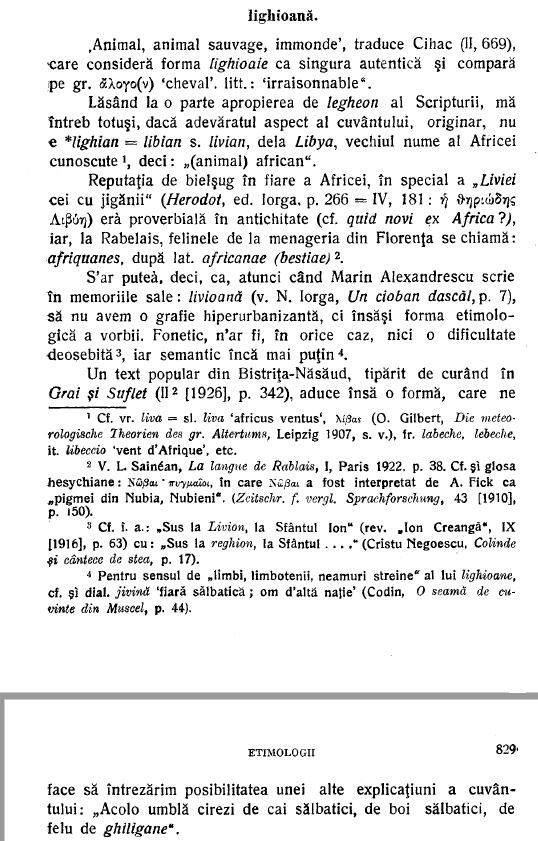
led by Sextil Puscariu, year IV, part 2, pages 828-829, a
possibleă etymological explanationă
(formulatedă
by philologist Vasile Bogrea):
from
păThe explanations seem erroneous to me. And forced.
The road
correct spellingâNtuli
seems to be:
Legion
(Romaniană)
– Legion (diabolicala)–
Legheonu (Coresi) – Lighioană
(secular) and the return to the "Legion" in biblical formă
Modern.
look să
I am contradicted.