The Wolf and the First Organized Romanian States
In the medieval period
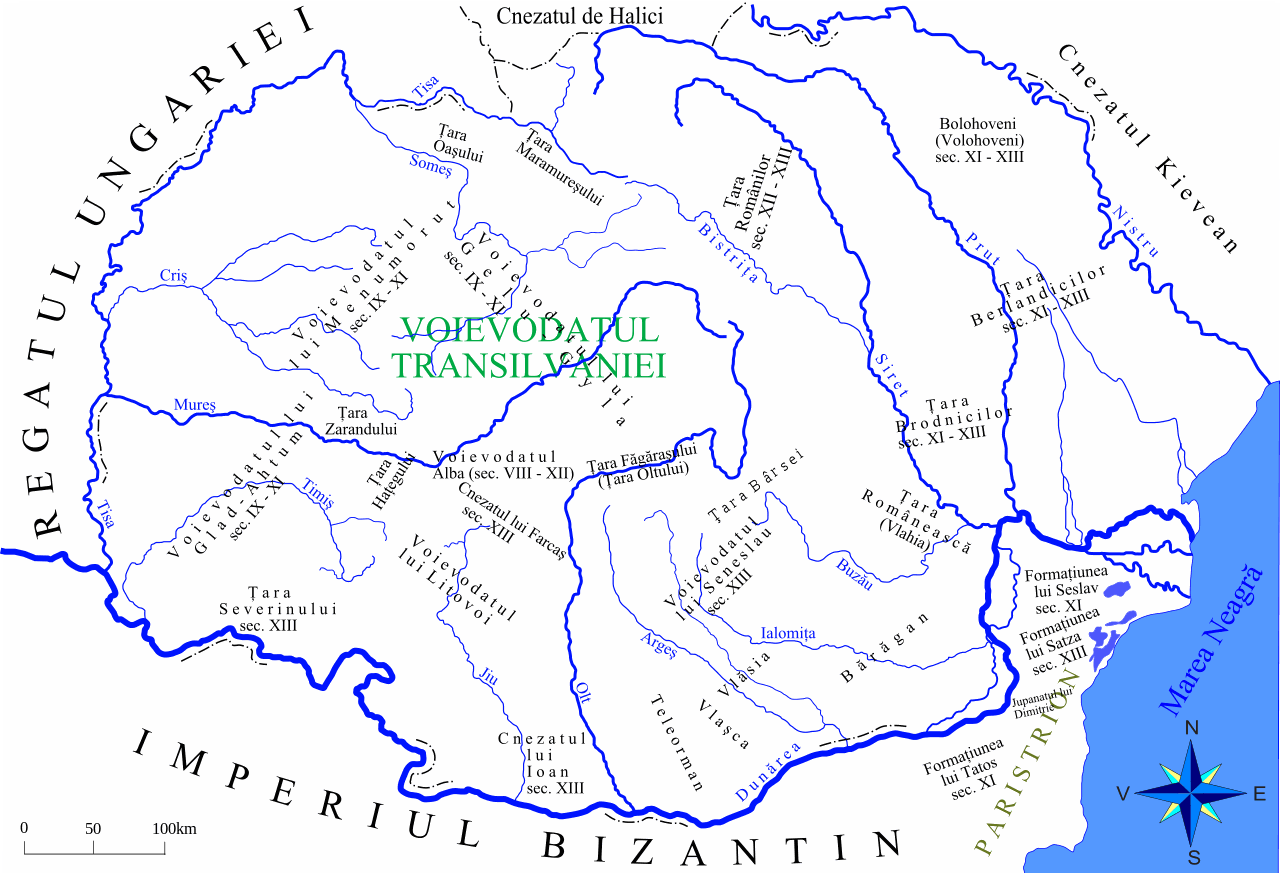
the first Romanian state formations appear (according to the Diploma
The Order of St. John, considered by many historians to be one of the first
clear written historical sources): Severin Country, John's principality,
the principality of Farcaș, the principality of Seneslau and the principality of Litovoi
(the rest of the territory of today's Romania being generically called
Cumania).
I will not enter into a
discussion about these first formations but I'm thinking about the name
the princedom of Farcaș. No, he was not Hungarian. Because that is not how it is
described in the Hungarian Diploma.
But in Hungarian farkas
means "wolf"„.
According to historians,
the area where this principality existed would also include Vâlcea.
But wolf /
vâlk = wolf.
The Wolf's Princedom. In
The land of the Wolves. Farcaș in Vâlcea.
History deserves it
thought.
“"In conclusion
these observations, let us say a word about what might be
called the mythical dimension of Dacian history. It is significant that
the only people who managed to definitively defeat the Dacians, who
occupied and colonized their country and imposed their language on them, it was the people
Roman; a people whose genealogical myth was built around him
Romulus and Remus, children of the Wolf-God Mars, suckled and raised
by the Capitoline Wolf. The result of this conquest and the
This assimilation was the birth of the Romanian people. In the mythological perspective of history, it could be said that this
people were born under the sign of the Wolf, meaning predestined for wars,
invasions, and emigrations. The wolf appeared for the third time on
the mythical horizon of the history of the Daco-Romans and their descendants.
Indeed, the Romanian principalities were founded after
the great invasions of Genghis Khan and his successors. Now,
the genealogical myth of the Genghis Khans proclaims that their ancestor
was a Gray Wolf who descended from Heaven and united with a
deer".
From Zalmoxis to
Genghis Khan – Mircea Eliade
Vilca
„"wolf", used like Lupul in Romanian onomastics with the same
mystical value. 1. Vîlc (Moț); -u freq.; -ul (C. Ștef). 2.2
Vilca s.; Vlăca b. (Giur 90); Vîlcescul, (16 B VI 92). 3. Vulcan
munt., 1494 (Rep D 168); mold. (Dm); – mountain, under Latin infl.
written Vulcan; -a s. with the same double spelling; Vlăcan (Giur 90);
Vîlcan/ul mare log. (16 B II 376); -a f. (AO XV 291); Vilcan,
-ești ss. 4. Vîlcomir (17 B III 495), Vlăcomir, olt. (Sd VII 4; AO
VIII 292). 5. Abbreviated: Vîlcomu t. (AO XIX 134). 6. Vilcasin olt. (17
B III 200) cf. srb. Vukasin. 7. + -cea, Vîlcea, appears as an anthroponym
from the beginning, in all the major regions: moldavia. (Dm; Ștef; 16 AI
593), ard. (Moț), munt. (Rel; 16 B II 377 etc.) and could have formed
in the field of the Romanian language from the surname Vîlcu, borrowed as
Hungarian Farcaș to replace "Lupu", adding the suffix
the most productive -ea or -cea, as in Cucea, Ducea, Marcea, Stîrcea,
from Cuc, Duca, Marcu, Stîrc and as in many other cases. County
Oltean bore a personal name, as is usually admitted, of
county in the 13th century, as well as Mehedințul and Romanațul, which without
reason are written with a final i. It is possible that in some cases, the name
to have received it ready-made from the glory, from the neighbors: Iorgu Iordan
(Loc. p.) derives it, in this case, from the personal n. blg. Бълче
„"little wolf" < влzкъ "wolf", reading Влzчa ( =
Vâlcea) (Rel. p. 175), the messenger of Basarab III (1478 – 1482), and E.
Petrovici (Linguistic Studies IV 75, 80) considers the name of the county,
written in 1329 sudstvo Bazчьско "Vilca County" as an adjective
Slavic feminine possessive, cf. Serbian vilča, Bulgarian vălča "of the wolf".
7. bis. Vâlcea is also written Vlăca: Vlăcia, mold. 1438 (Sd VI
125); + -in(a): Vlăcina (16 AI 237). 8. With č > ț: Vîlțea b.
(C Ştef) and rotated: Vîrciu (Moț), if he has no other
origin. 9. Vîlciu, P., act.; -l t., channel to the Danube. 10. Valceiu
b. (Sur XXII), perhaps under infl. dim. vălcel < noun. vălceá. 11.
Vâlcoiul, D. (IO 176); Vîlcioiu, M. (First Div). 12. + -oci: Valcoci
b. (17 BI 383). 13. + suf. slav -ov: Vîlcov s., who translated the
medieval Greek Lykostomion "Wolf's Mouth". 14. Vălcău village 15.
Vulcuțiu ard., act. and Vulcești s. (BCI I) with u < t, under infl.
srb.-cr. Vuk. 16. Vâlceanul m. log. 1549 (D Gorj), n. of apart.
local. II. Other derivatives. 1. + -san: Vîlcsan (Cat; Ștef; Div 59;
16 B 12) and Vlîcsan, probably received directly < blg. Bлъксан
(Miklosich); for its equivalence with Vîlcan we have the case:
Vîlcasn Florev "of Flora", also called Vîlcan of Flora (Fior 82,
101, 120 ) and Vlăcsan Viorin (Div 59). 2. Russian forms волк
„"wolf": Volcineț s. and Volcinschi, Moldavian (Arch) 3. From Serbian-Croatian.
Vuk "wolf": a) Vuc b., olt (Tis); Vucoaia, Maria (17 B III 330) b)
He was calling. (17 BI 32, II 289, III 131; Hur 323); Vucia (Giur 339);
with afer. prob., Ucea s. ard. c) Vuciu, D. act. d) original forms
you are Serbian: Vucina b. (Tis; Year C III 748); – pan (IO 260); Vucenic
and Vucetici (Arch).