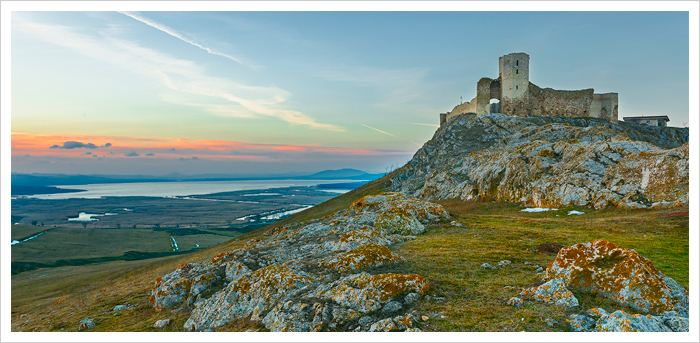
Easter of the Blajins. My Dobrogea.
„"In the beliefs of our people there are still traces of
historical facts regarding Dobrogea. And what is curious and interesting at the same time
It's time that we find these memories outside of Dobrogea and even far from it,
in Bessarabia, Moldova, Bucovina, northeastern Transylvania and Maramureș, and not
we find them in Wallachia, Banat, Hungary, nor in southwestern Transylvania.
In these Romanian countries, the people celebrate a holiday called
Easter of the Blajins or Easter of the Rohmans.
The Blajins or Rohmans are said to be Christians, Romanians of the
ours, who live in a distant country, right on the edge of the sea, on
where the waters flowing from Bukovina flow. There they are under pagan power
and they have no way of knowing even when Easter is. Only when they see many waters
eggs and red eggs, then they know it's Easter here, and they start
They also celebrate Easter, they also make Easter cakes and cozonacs, red eggs, just like us.
that in almost all countries where Easter is celebrated, and especially in
most about the North: Transylvania, Bucovina, Maramureș, women take care of
Easter should collect all the eggshells and put them on the hook, like from hook to hook
May the water carry them to the land where the Blajins are.
The custom of throwing red egg shells into the water is found
until, and in some communes among the Romanians of Galicia. The Blajin Easter is celebrated
in some places on Wednesday after Easter, in others after Thomas Sunday and in
the third and fourth week after Easter. Leaving aside the details of the
of this popular celebration, mostly due to fantasy and which
together with the bibliographical data are found in the writing "Holidays among Romanians"„
by Sim. Fl. Marian, let's move on to some important issues. Who are the Blajins?
or the Rohmans? From everything that is said about them we gather that: a) They live next to
Sea. b) They live where the waters of Bukovina flow. c) They live in the country
pagan.
According to Mrs. Voronca, the Blajinii or Rohmanii are a people from
the emigrants who passed over our people, and who through their kindness and
His gentleness made us likeable. But somehow the people say that the house
theirs is over the sea, it is more possible that the Blajinians are a people that ours
they passed him by during their emigration here, or that they had him as a neighbor or brother and
They left him there across the sea, where ours came from.
According to a press release by Vas. Lucan: "The People of Mihalcea" say
that, "The Rohmans are Romanians like us, even better than those from
Moldova". .. We believe that the Rohmans or Blajins are Romanians and that means
our brothers whom we left behind, not across the Sea, as Mrs. Voronca says,
but to the Sea, in the part where the waters of Bukovina flow, that is, Dobrogea. One of
the invading peoples, the Visigoths or perhaps later even the Bulgarians, occupying
Dobrogea, part of the Romanians there left this region, retreating
in the mountains, to the north, some remained in place. Those who remained in place were very
It is good to be called gentle, by those who have left, because gentle
It means gentle, suffering, patient. Those who left Dobrogea with
time, due to various invasions, they kept rising towards the North and reached
to Maramureș where they took with them the memory of their brothers
gentle ones who remained at Mare.
The word gentle being Slavic, we must admit that leaving
Dobrogea, or the separation from Blajini was made following contact with the Slavs,
therefore much later than the Visigothic invasion. The invaders therefore had
could more likely be the Bulgarians. We say Bulgarians, because in order to make a
part of the population of Dobrogea to leave it, there had to be some
invaders who would come to Dobrogea, on the right side of the Danube.
We then say that the land of the Blajins is at the Sea and not across the Sea,
because the outflow of Bukovina waters is from this side of the Sea. In the course of so many
For centuries, the imagination of the people, having no point of support, could not
well to change historical truth. And he changed it quite a bit. For example,
The Romanians from Boian and Comănești say that the Blajinians live in a very desolate
sea on the shore of the Sea; those from Suceava, Rădăuți and Fundul Moldovei say they live
in the Islands of the Seas; the people of Ilișești say they live in a pagan country;
The people of Marginea say it's somewhere in a country far to the east,
some prisons where Christians are locked up for life; those from Mihalcea say that
The Rohmans are Romanians and they live very far across the sea, right there by the
where the Jews are, in Jerusalem, but further away from them.
Other Romanians, also from Mihalcea, say that the Blajinians live under
earth, in the other world, where there are cities and villages like ours; and those in
Băișești believe and say that they live on the border with Heaven and that, with them, it is always
warm. We believe that the disentanglement of Moldova with Romanians from Maramureș under the leadership
Dragoș's, it is nothing more than a return of Romanians from Maramureș to Moldova, that is
a return to the homeland. These kinds of returns to the homeland are quite
known in History. The Argonauts' expedition was nothing more than the return to
Colchis. What tradition says is that the Blajinians live in a pagan land,
also corresponds to historical facts. This means that at the separation
The Romanians, like the Blajinians, were Christians, and those who came upon them were
pagans, like the Bulgarians were when they invaded.
We know that in 1877 we took Dobrudja from the Turks and that
before the Turks it was sometimes of the Romans, sometimes independent, sometimes under
the rule of the Romanian-Bulgarian empire, then under the Byzantine one; and in 680
we know that it was conquered by the Bulgarians. Conquered, therefore, by the Bulgarians before it was
Christians. But the people do not know all this, they only keep in mind the fact
initially that those who came over the Romanians, and under whose rule they remained
The Blajins were pagans.
We then claim that the Blajinians are Romanians, because otherwise
The Romanians would have had no interest in remembering them, they would have forgotten about them.
as they forgot about many others. But being Romanians, of the same race, undoubtedly
those who remained were closely related to those who left. Those who remained will be
were brothers, sons; parents, relatives of those who left, there will have been people
beloved and precious, whom in a time of distress, in a balance, in a need
They left him a great gift that his heart would not let him forget. This
Love also explains the preservation of memory, and the punishments that were imposed as a sanction.
for the preservation of customs related to these memories. Thus, it is said that it is
It would be a great sin not to celebrate the Easter of the Blajins.
Anyone who doesn't celebrate or says anything bad about this holiday will be kicked out.
God. If these beliefs are also found among the Slavic population that lives with
The Romanians, it is possible that the Slavs borrowed it from the Romanians, and it is even possible
that together with the Romanians, some of the Slavs from along the Danube also emigrated upwards.
However, the Blajinians must be Romanians, as the largest ethnic group
The majority of the population where this tradition is found is made up of the Romanian population
from Bessarabia, Moldova, Bukovina and Maramureș.
From the fact that the people know that the Blajins are on the side of the Sea, it follows
also that, at one time, they lived together, and the memory that the Blajins are
next to Mare, it is precisely the memory that he left them next to Mare and therefore that
The Blajinians are Romanians like them. Our opinion is also supported by the fact that
This belief is not found among the Romanians from the lower part of Bessarabia and
Moldova, nor to those from Wallachia, Banat, Hungary and the southwestern part
of Transylvania. This just proves that the Romanians who left Dobrogea, the comrades
and the relatives of the Blajins, retreated only to the North, and the southern parts were
roamed and occupied by invaders. From the use of these names:
Blajini and Rohmani, it still results, something: The name Blajini is used by
custom by the Romanians, as is natural: knowing that they are relatives of their own,
I don't call them Romanians anymore, I just call them Blajini, as if to say: you
ours, the gentle ones; and foreigners call them Rohmans, Rocmanis, etc., meaning they use
the word Romani pronounced as some foreigners might have pronounced it. So even
The words Blajini and Rohmanii show that the Blajini are Romanians.
All of this shows us on the one hand our connections in
antiquity with Dobrogea, and on the other hand why folklore is important,
the study of legends, customs, beliefs and all productions
intellectual, aesthetic values of the people, which can give history a material on which
which archaeological research has not been able to provide.
Th. D. Sperantia
The New Romanian Magazine: For politics, literature, science and
art, April 14, 1913