Living life with the awareness of death in ancient Rome and Greece
Living life
with the consciousness of death in ancient Rome and Greece
Eliza M.
In
In this work I have tried to describe the funerary space, with the related rite, using
to poetry and helping me of objects and
funerary monuments. The relationship between man and divinity is depicted on the monuments
funerals among both the Greeks and the Romans. Through them, we can participate
to their rituals and beliefs. Temples, works of art, were dedicated to
exclusively to the divinities. By extension, tombs were also seen as
sacred buildings. Through the inscriptions on the tombs or with the help of
of some stars, we can enter the religious intimacy of the Greeks and Romans.
I have
I chose to present the Roman space first, because I wanted to highlight
the desire and fear of the Romans for oblivion, implicitly, for their erasure from history.
The Mausoleum of Augustus is an example of this: the site chosen in the Field of Augustus
Mars has the purpose of being reminded by
Roman soldiers, while waiting to be welcomed into the city; the size
The Mausoleum approaches the buildings dedicated to the gods and, through this, one can see
the desire to be deified, to gain an eternal place in the world's memory.
Greeks
follow the lesson given by Homer: to take advantage of what the present gives you, but to live
noble in the present. Death brought only an existence without memories, without strength,
a life like a shadow, in a world of shadows. This perspective on life made him
the Greek to aspire to perfection during life. The Greek lends to the god,
in the statuary representations of the gods, the perfection of the human body. Life is not
is banal, it must be lived in wisdom. If we think of the heroes
Greeks, who were not immortal like the gods, but only influenced people's lives after
death, we can conclude that the Greeks gave us heroes whom we admired and who
influence our lives through their works, whether we are talking about philosophy, poetry or
art.
ROME
“"Tell me, maiden, speak, what the rush towards means
river,
What do these shadows want? and why do the shores
Some leave them and others with oars - the water is ripe, isn't it?”
“"Son born of Anchises, the only offspring of the gods,
The deep pool of Cocytus, see the marshes of Styx,
The gods they swear by and fear for their own power.
All this you see is devoid of the pit of multitude;
Charon the ferryman is that one; those taken across the shore, buried.
It is not permitted beyond the fierce shores and on the roaring waters.
They pass before their bones rest in their graves.
Thus for a hundred years I wander, flying around the shores;
Only then, having been received, do they see the longed-for breasts again.”
(Publius Virgil)
Brown, Aeneid)
The Romans attached great importance to burial. Aeneid
Virgil's, written during the time of Augustus, is an example of this.
No one wanted to wander for a hundred years.
The Romans' conceptions of the afterlife were influenced by
both the beliefs of the Etruscans and those of the Greeks. The burial ritual
is depicted by Virgil at the funeral of Polydorus: "So we prepare his burial
Polydorus and much / Gathers in a mound of dust;”
burial as well as cremation. The choice depends on individual preference or tradition.
The practices are respected and, through them, the deceased is respected.
Regardless of the burial method, the ritual was the same. Before leaving
At home, the family washed the body and placed a garland of flowers around the neck.
and a coin, with which to pay Charon.
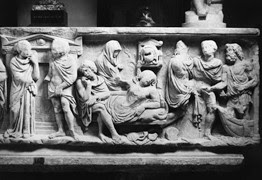
https://iconographic.warburg.sas.ac.uk/vpc/VPC_search/record.php?record=71681
Now is the time to make the wax mask. A
A fir or cypress branch was placed at the door to warn others
that there is a deceased person in the house, therefore the house is impure. Funerals
they started from the deceased's house, from where the dead person was accompanied by a procession
(funeral pump).
Theodor Mommsen describes the funeral ritual of the Romans,
thus: the procession was opened by mourners, musicians and dancers. One was
dressed and masked like the deceased and was followed by the other actors in a
procession of the ancestors. A significant feature was the parade with masks
of the ancestors, made of wax. The masks were kept in cabinets in the atrium of the
houses. These masked actors walked with pomp and stood on the rostra during
the eulogy ceremony. The masks represented the genes and ancestors of the deceased, through
This shows hereditary inheritance.
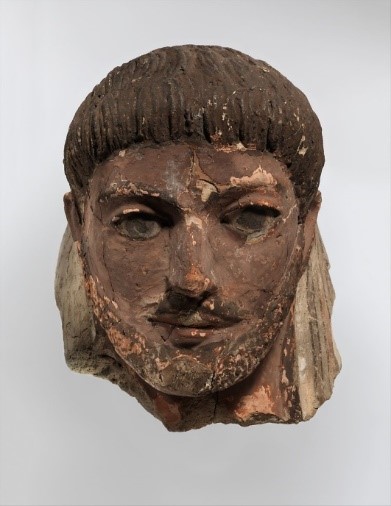
https://www.metmuseum.org/art/collection/search/547853
In addition to masks, the actors also wore appropriate official attire,
of the ancestors. The deceased was placed on the catafalque covered with beds of
purple sewn with gold thread and immaculate linen. The deceased wore all the insignia
HELD alive and surrounded by armor
the enemies he had killed and the crowns he had won. In the aftermath
The mourners walked along the catafalque, all dressed in black and without adornments. In
In this way they reached the forum where the body (or a wax effigy of the deceased) was deposited.
deceased) on the Rostra, and here an elegy was offered to him.
The ancestors got off the chariot and sat on chairs; the
closest member of the gens climbed onto the Rostra tribune to report to the crowd
gathered, the names and deeds of each of the men seated in the circle and the names
the deceased. The most important person in the family gave him the last kiss,
He would close his eyes and call out the deceased's name to confirm death.
(conclamation).
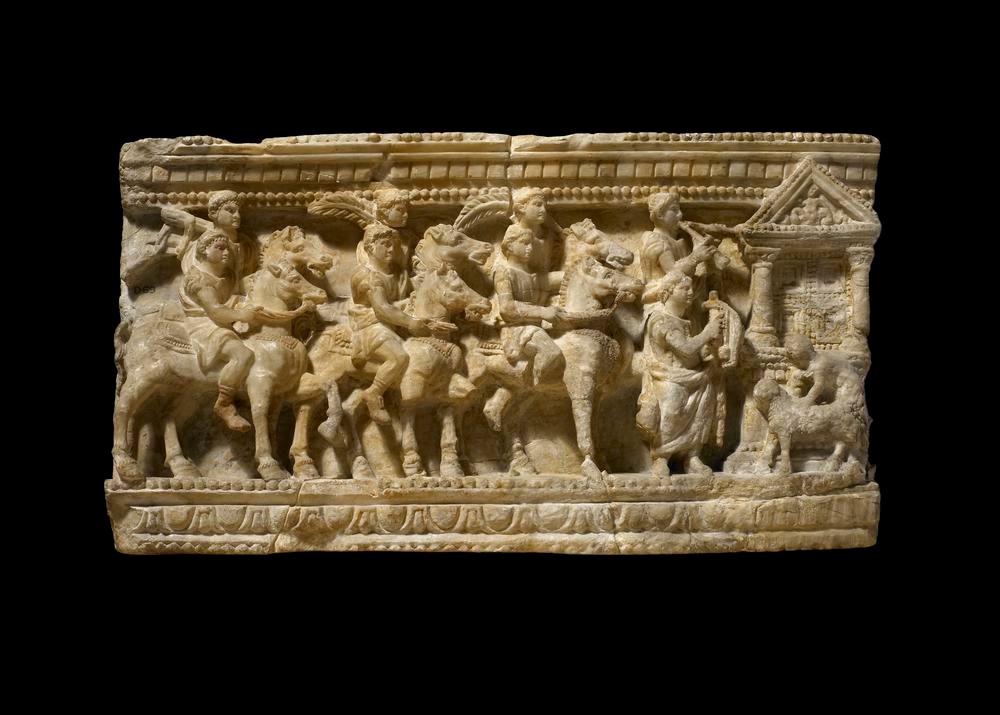
https://www.britishmuseum.org/collection/image/1506120001
After the ceremony in the forum, the body was carried to the site
crematorium. After burning, the remains were collected and stored in the tomb.
Mircea Eliade shows us what the rites continued with
funeral in the regular cult of the “ancestors of death” or Mani. Two holidays
were dedicated to them: parenting, which
was held in February and Lemuria in
May. On Parentalia, the dead returned to earth and nourished themselves with offerings of
on the graves. During the three days of Lemuria, the dead returned and visited
the homes of their descendants. In order not to kidnap the living, the head of the family took grain seeds
black in his mouth, then, throwing them away, he would utter the formula of redemption and making
noise with an object, repeat nine times: "mania "To my parents, go away!"”
Titus Livius - in his description of the Devotio rite - tells the story
about the offering made to the Mani, in which the consul Decius dedicates his life to victory against
Samnites. The transfer of the life of the sacrificed one in order to obtain something.
Virgil -in describing the funeral of Polydores-
he also describes the rite for the manes to whom altars were erected, adorned
with purple ribbons and black cypresses. They poured pots of milk over the grave
lukewarm and chalice with the holy blood of the sacrifices. After they had enclosed the soul in
pit, they shouted, calling him for the last time.
Rome was confronted from an early age with the Etruscan world and
was influenced by their culture. In both cultures, the dead are carried on
the other world of Charon. Unlike
of the Etruscans, where Charon appears as terrifying, the image of Charon on
funerary monuments appear alongside other infernal demons, they are often winged,
in their hands they hold torches or hammers, forks, razors with which they torment the souls of the dead;
among the Romans, Charon is present in their image, as Virgil presents him in
Aeneas: an energetic old man, with ragged clothes, a long beard, and sparkling eyes.
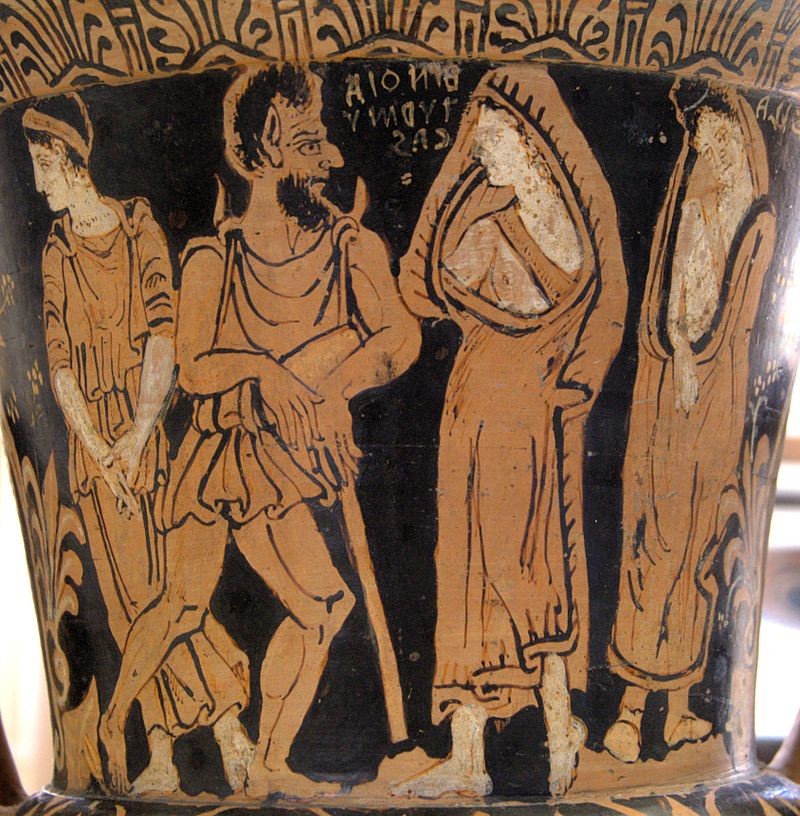
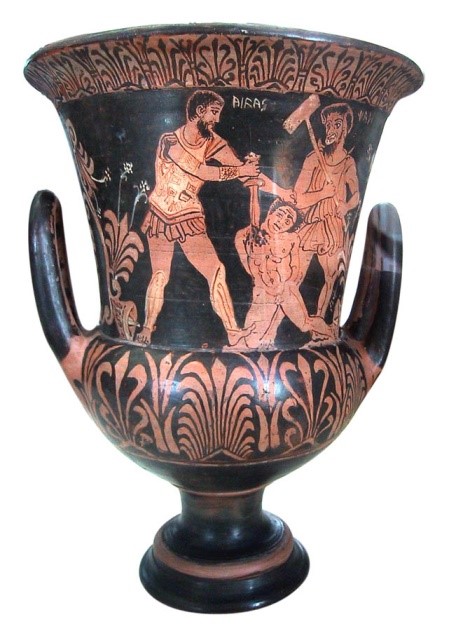
https://commons.wikimedia.org/wiki/File:Charun_hammer_Cdm_Paris_2783.jpg#filehistory
Roman cemeteries were located outside the city. This
we learn it from Cicero who tells us that it is specified in law X of the law
of the 12 tablets: "a deceased person must not be buried within the city
“" (De Legibus, 2,23:58).
The tombs were well-kept and beautifully constructed, as
For a long time, the belief prevailed that not only bodies but also spirits reside in tombs.
souls. On the other hand, the Romans wanted not to be forgotten after death, so
they built tombs to be seen, true monuments display and communication.
If the place of the gods was in the temples, the Romans they build a road to the deities, they seeks the mythical descendant. His route
We see Augustus portrayed in Aeneas as a religious person who fulfills
strictly observes religious rites, he does not forget to take with him the penances he
brings from Troy to Latium. In Rome, the genius of Augustus was honored alongside the divinities
family and household matters. The genius was the protector of that house, and the genius of
Augustus was the protector of the entire empire. Augustus was climbing the ladder of deification,
and in the year 12, Augustus took the title of pontifex maximus. He was the supreme
authority in controversial religious matters and the keeper of all ordinances
priests. During his lifetime, Augustus
was worshipped as a god, his genius entered the ranks of the divinities, and after
his death he was declared "divus" and two monuments were erected in his honor
Monuments: Altar of Peace and the statue at Prima Porta.
Following a decision of the senate, on the Field of Mars (Campus
Martius), Augustus built his tomb during his lifetime. During
In the late republic, Roman elites built tombs along the roads
who entered and left the city, but not on the Field of Mars. It was a privilege
which required the consensus of the senate.
Augustus
chose a tumulus as a funerary monument. The circular structure was inspired by
Etruscan tumuli.
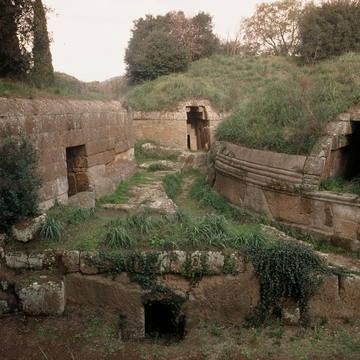
https://whc.unesco.org/en/list/1158/
On a basis
rectangular, a large cylindrical structure carried a tumulus planted with
cypresses. The outer body had a diameter of 85-87 m and a height of 12 m.
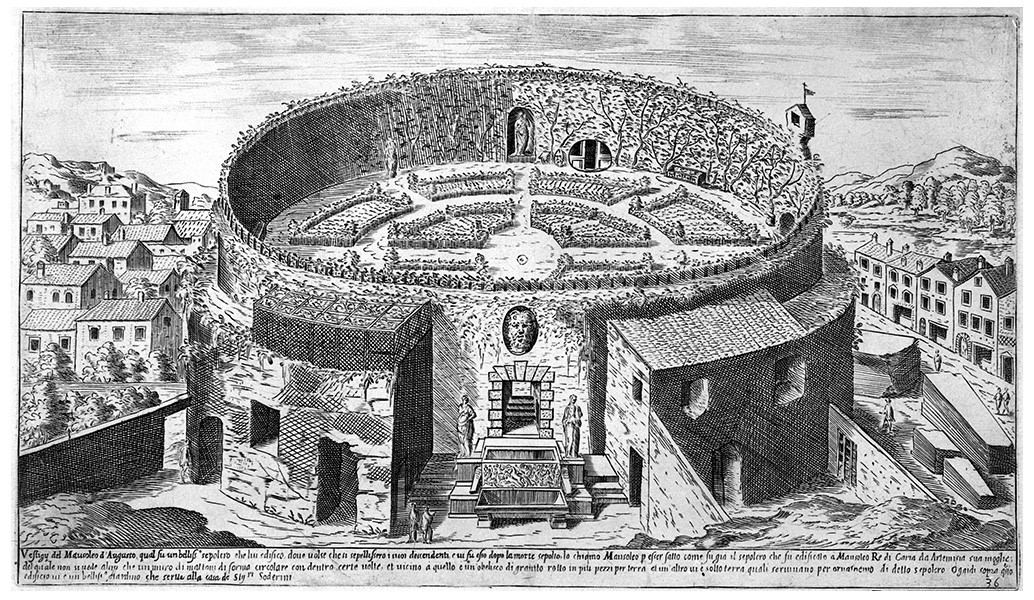
https://www.mausoleodiaugusto.it/en/timeline/
Without inscriptions and material attesting to a clear date of construction,
the date remains speculative and undecided. (Stoetenius: he built the mausoleum in
28 BC; Virgil (Aeneid) while writing about the funeral of his nephew
Augustus Marcellus in 23 BC).
Augustus not only built his mausoleum, but he also wrote his
and funerals. His will contains instructions about organizing the funeral
(Res Gestae Divi Augusti). The chaotic events since Caesar's death have made
for the elites to leave their instructions. On the pilasters at the entrance to the mausoleum, they
His achievements were inscribed in bronze. The original inscription has disappeared,
but three copies were found in Galatia and Anatolia, a Latin version and one
in Greek. In the 38 chapters, we find his course in politics, honors
religious and special triumphs, but also the recognition of his merits in wars
and in civil activity.
On August 19, 14 BC, Augustus, the first Roman emperor,
dies at Nola. His body was brought to Rome with great procession and was
brought the funus imperatorum. He had the double Laudatio, the official one is spoken by
Tiberius, the second speech is delivered by Drusus. After cremation, the ashes were
placed in the Mausoleum.
GREECE
„"The burial-honor Creon gave to
Only one of the brothers, but he put a stop to it
At the other person's funeral
…………………………………………
Do whatever you want! I'm still burying him. I love him.
"To die with a peaceful soul"”
Sophocles, Antigone
The cult of dead ancestors was considered one of the obligations
religious duties of the family, as it was her responsibility to take care of the funerals;
on this occasion, the deceased was provided with everything that was considered necessary for life
from beyond. Antigone will bury Polynices despite his prohibition
Creon since the divine laws are above the command given by Creon, even if
Violation of this edict will bring death.
The extinction of the family and the lack of descendants were considered a
misfortune, because in this way the care for the dead ceased, whose
spirits could disturb all the citizens. It was inadmissible to leave a corpse
unburied, as it caused harm to the entire city. If he died of
violent death, the family had the obligation to avenge the blood.
Religion before Homer depicts the gods as personifications
of the powers of nature. The religious atmosphere gives you the feeling that the whole
nature is permeated and captured by the divine.
For Homer's contemporaries, the gods are no longer beings
natural, linked to certain physical elements, they are beings like humans,
free and interfering in people's lives. Regarding the future life,
the Greeks believed that the soul, after separation
body, he goes to the kingdom of Hades and his wife Persephone. The soul keeps
the resemblance to the living body, but without the consistency, is like a shadow. The Kingdom
The underworld of Hades is separated from the world of the living by the river Acheron. There, life
is experienced as a shadow. Good done on earth is not rewarded and evil is not
is punished. Corpses are not buried, but burned. Funeral honors and
Cremation is a necessary condition for the soul to reach the afterlife.
Animal sacrifices were made during cremation. As long as the corpse is not burned, the soul wanders
through the world and has no rest. Therefore, for the rest of the souls, those who do not
could be buried, a cenotaph was erected, to serve as a place of
worship.
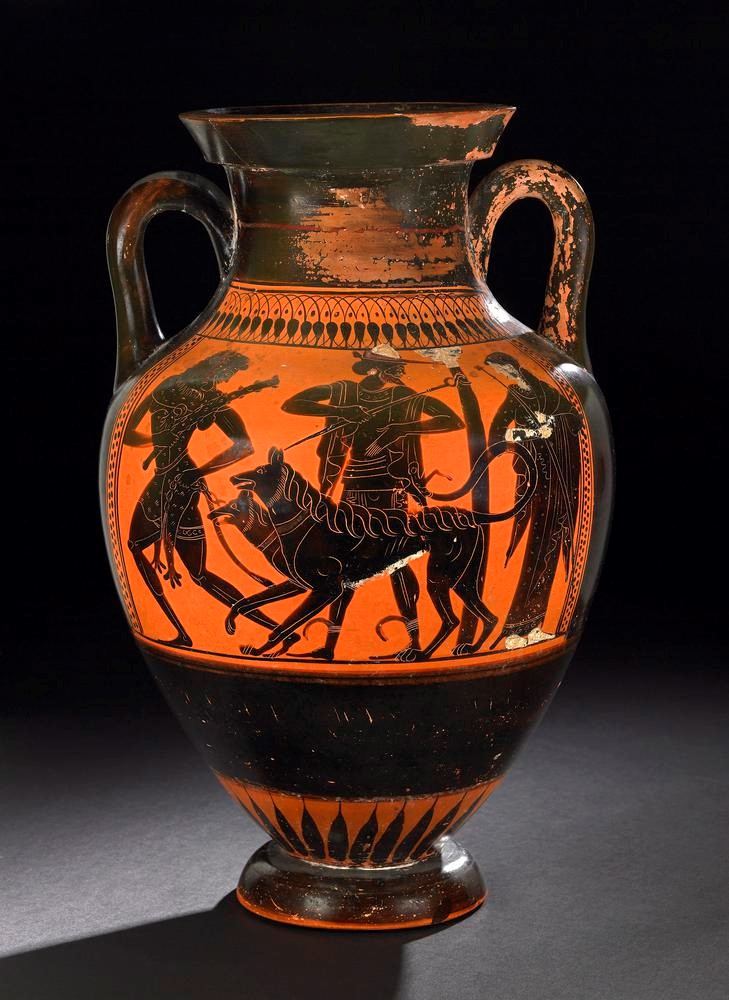
Black-figure amphora. Cerberus with two
The heads are tied with a rope by Heracles. In the second plan is Hermes.
Death, in the period after Homer, is viewed with
resignation. The abode of the dead is in the realm of shadows, ruled by Hades and Persephone.
Its great gate stands open and once entered, there is no way out. The terrible
Cerberus is an untamed gatekeeper.
https://www.britishmuseum.org/collection/object/G_1893-0712-11
At the end of the earth
to find the Elysian Fields, where the gods' favored people live a happy life. The Kingdom
Hades is separated from the world of the living by four rivers, over which
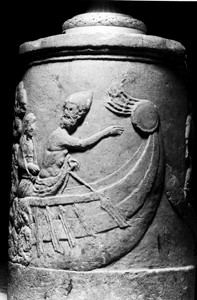
The souls are ferried across by the ferryman Charon, who is paid an obol.
In Homer, funeral rites are described on the occasion of
of Patroclus' funeral: burning the body on the pyre, sacrificing
prisoners and favorite animals, the erection of a tomb. Death was
because of impurity. It was generally forbidden to bury the dead inside
sacred grounds. In 426-425, the Athenians who administered the sanctuary at
Delos received advice from an oracle to purify the entire island. They
destroyed all the tombs that were still on Delos and transported
the recovered funerary material, on Renea Island.
There was respect, trust, sympathy for the gods, and
final, fear. This is how we can explain the anthropomorphization, they were stronger, but similar.
Besides the gods, there were also people and heroes. An essential feature of heroes is
their death, they are distinguished from the gods, since they are not immortal, and they are distinguished from
people, in that they act even after death. These gods are worshipped by a
cult with well-defined characteristics: prayer, offering, sacrifice, holidays
public, games.
The fortress is the framework of religious life, you are a citizen of the fortress
to the extent that you participate in its common beliefs. This means
that religious life occupied a central place for every citizen. They had to
to respect religious and funeral rituals.
The structure of the cremation graves was a simple pit,
dug in the ground, the funeral urn is placed in it and a few vessels, as an offering brought
Half of the grave is filled with earth, and on the surface rises
a tombstone serving as a stele, often accompanied by a large vessel
large intended to receive libations.
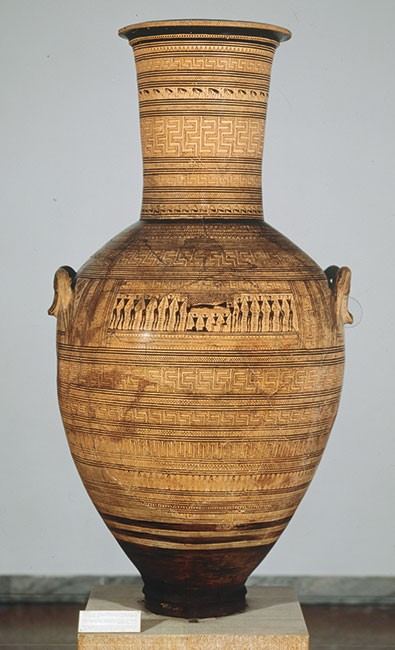
1.5m vessel, the Greek ceramist introduced a scene in which the dead man appears placed on a
catafalque, surrounded by mourners.
https://www.namuseum.gr/en/collection/geometriki-periodos-3/
Geometric necropolises preserve traces of the funerary cult:
In Attic cemeteries, near the tomb, ashes of sacrifices and
the large vessel above which had served the libations. Beside these, a large stone
stuck in the pit or near it, serves as a sign (sema). Through an evolution
it will become the funerary stele.
https://www.namuseum.gr/en/collection/klasiki-periodos-2/
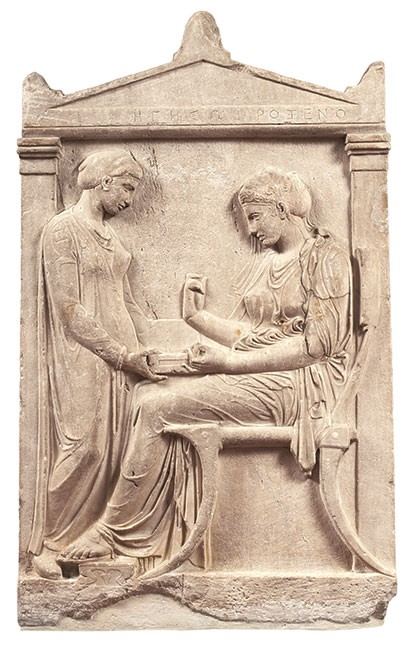
This is a typical example of an Attic funerary relief. The young woman
The dead woman is seated on a chair, resting her feet on a stool. The husband
They offer him a jewelry box and he looks at the one who is no longer with him.
According to the inscription her name is Hegeso. The architecture with the two pilasters are
testimony to her noble origin.
At first the name of the deceased was written on the barely sketched block,
then it became much more elaborate: the well-cut stele, tall and narrow, slightly
pyramidal, began to be embedded in a wider base. In Crete appeared
the idea of decorating the stars with a representation worked in depth and which
presents the structure of a story: woman with spindle, armed warrior. Mortals
they were represented on the stars as being like gods, slightly idealized.
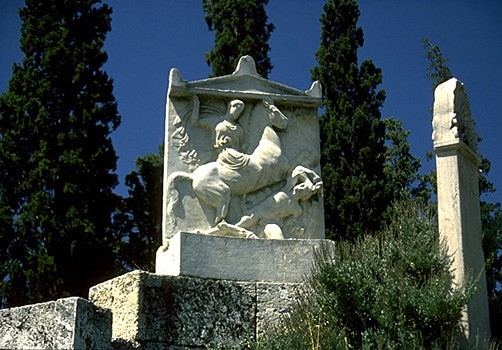
In the 6th century, the tombs were decorated with bas-reliefs with
the face of the dead.
made of marble. The stele was placed on the tomb of a hoplite, Ariston, inscription
which appears at the base. The warrior, fully equipped, advances with his spear raised.
The sculptor, according to the inscription on the lower part of the stele, was
Aristocles.
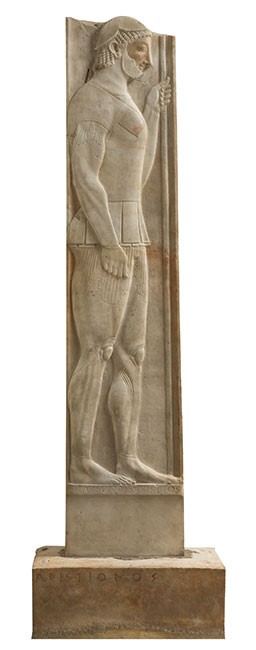
https://www.namuseum.gr/en/collection/archaiki-periodos/
(hoplite star
Ariston), or ronde bosse statues, which constitute the beautiful row of funerary kuroi.
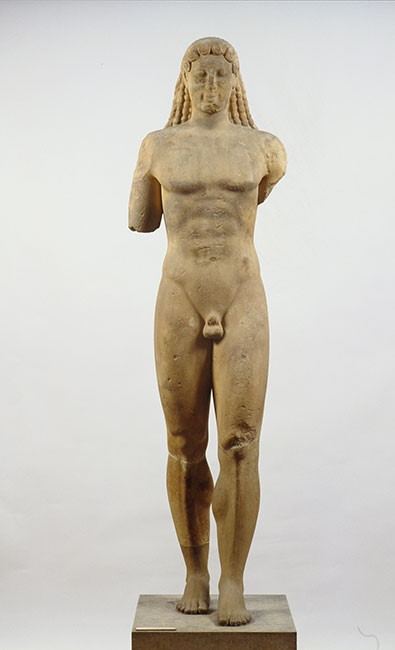
https://www.namuseum.gr/en/collection/archaiki-periodos/
Representations of
on the graves they are not similar to the deceased, the portrait does not aim for resemblance,
it represents the idealized deceased, in full strength and beauty. Greek artists gave importance to symbols
represented. On a stele from Laconia, (the relief from Chrysapha)
the serpent associated with the earth deities rises. Two people also appear
who bring them offerings. These represent children (the representation is minuscule
in relation to the deceased) who honor their parents because they became
immortal, like the gods.
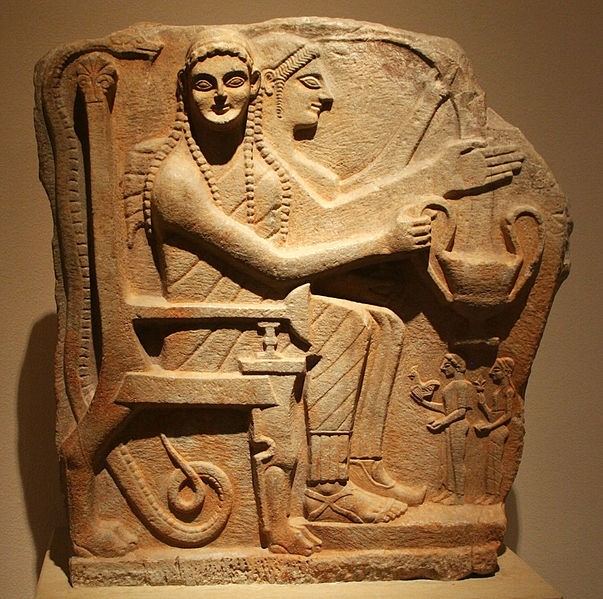
Greek artists took their freedom and healed
the statues of the Egyptian flatfoot, gave them momentum, raised them to the level of
Greek architecture, gave them immortality through the admiration of those who would come.
In a highly subjective conclusion, I can say that the Greeks
they saw the immortal in man when they represented him, and the Romans represented him
to make him immortal; the Greeks sought the universal, the Romans sought
the particular, they individualized it through real features; the Greeks built
performance spaces where music, theater, sports were born; the Romans have
built performance spaces for the same arts, but added a
splash/"splash" of violence.
Bibliography:
1.
Publius Virgil
Maro, Aeneid, European Institute, 1997
2.
Theodor M, History
romana, vol I, Scientific and Encyclopedic Edition, Buc, 1987
3.
Mircea Eliade, History
of religious beliefs and ideas, vol. II, Scientific and Encyclopedic Ed., Buc,
1986
4.
Mircea Eliade,
History of religious beliefs and ideas, vol. I, Scientific Publishing House, Buc, 1991
5. Francois Chamoux, Greek Civilization, vol. I and vol. II,
Meridiane Publishing House, Buc, 1985
6. JJWinckelmann, History of Ancient Art, vol. I, Publishing House
Meridians, Buc, 1985
7. Sophocles, Antigone