When the Circle Becomes a Crescent
There are political gestures so small that they pass for graphic design. And precisely for that reason, there are political gestures that become dangerous: because they are small enough for no one to consider them worth noticing.
Look at the picture.
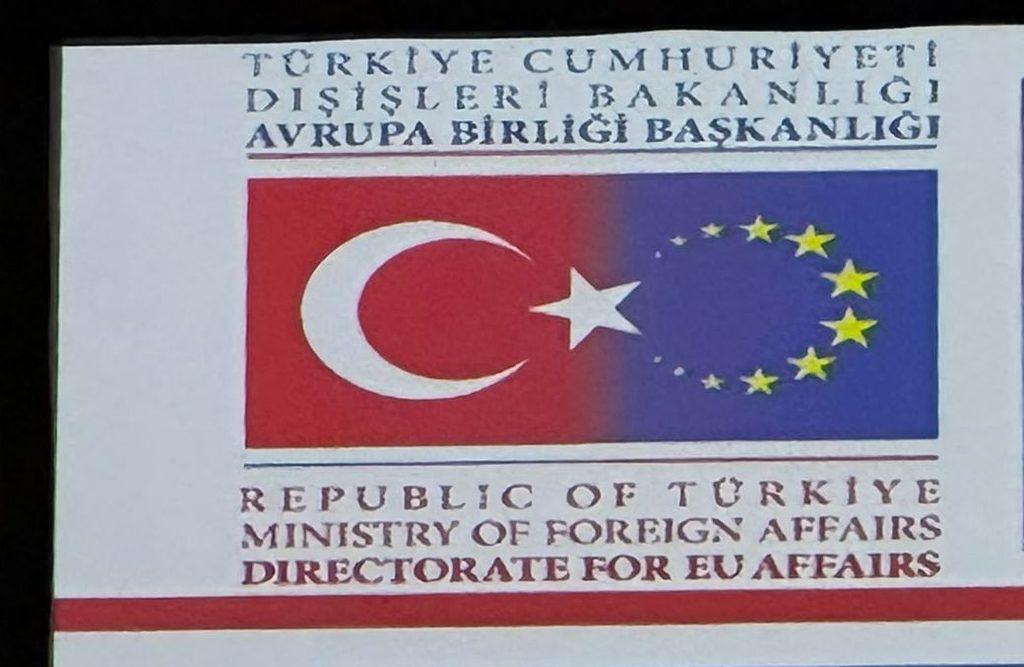
The twelve stars of Europe — conceived as a circle, as an image of unity, continuity and equality — have been removed from their own geometry and arranged into an arc that, with little subtlety, echoes the shape of a crescent. At the center remain Turkey's crescent and star. Around them, Europe appears to bend.
This is not about Islam, and even less about Muslims. Europe is, and should remain, confident enough in itself to accommodate Christians, Muslims, Jews, atheists and people of every conviction among its citizens without treating diversity as a threat.
The problem lies elsewhere.
The problem begins when the symbols of a civilization become so undefended that they may be rearranged according to the symbolic needs of a diplomatic interlocutor, while European institutions look on with the polite indifference usually reserved for a matter of protocol.
The European flag is not a collection of twelve yellow stickers to be moved around according to a designer's taste. The circle is itself the message.
To turn it into an arc is not merely to move a few stars. It is to alter the symbolic sentence itself.
And here lies the irony.
Contemporary Europe repeats almost obsessively words such as "values", "European identity", "common heritage", "rule of law" and "fundamental principles". Yet when these things must be defended not in a two-hundred-page treaty, but in a single square centimeter of imagery, institutional courage sometimes seems to evaporate.
It is difficult not to see in this composition an involuntary allegory of Europe's relationship with its own memory.
The crescent remains a crescent.
The star remains a star.
Only Europe changes its shape.
And perhaps this is Europe's real problem today: not the existence of strong civilizations around us, nor the fact that they assert their symbols. They are perfectly entitled to do so.
The problem is our growing inability to assert our own.
Europe was not born in a vacuum. However inconvenient this may sometimes be for contemporary bureaucratic discourse, it carries layer upon layer of Greek, Roman, Christian, Jewish, Enlightenment and humanist memory. Cathedrals, medieval universities, Roman law, Greek philosophy, the Reformation, the Renaissance and the Enlightenment are not picturesque accidents encountered on the road to Brussels. They are part of Europe's genealogy.
To acknowledge this genealogy is not to demand a confessional Europe.
It simply means refusing an amnesiac Europe.
There is a strange form of Western provincialism that considers it sophisticated to minimize one's own symbols, while treating the assertion of everyone else's symbols as a legitimate expression of cultural identity. A mature civilization should be capable of both things at once: respecting the symbols of others while refusing to be embarrassed by its own.
True tolerance does not require symbolic self-erasure.
On the contrary: only people who know who they are can truly encounter others who know who they are.
That is why the photograph is more interesting than it first appears. Not because it proves the existence of some conspiracy, nor because twelve stars arranged in an arc could alter the destiny of a continent.
But because images sometimes possess the cruel talent of summarizing entire eras.
In a single emblem, we see a state preserving its historical symbol intact, and a Europe whose stars may be rearranged to suit the composition.
Turkey should not be condemned for asserting its identity.
The uncomfortable question must instead be addressed to Europe: Why does it seem so natural that European identity should be the negotiable part of the image?
And if the answer is that "it is only a logo", then perhaps that is precisely the problem.
Civilizations do not always disappear when their walls are torn down.
Sometimes they begin to disappear when their own symbols no longer mean enough for anyone to object when they are redrawn.