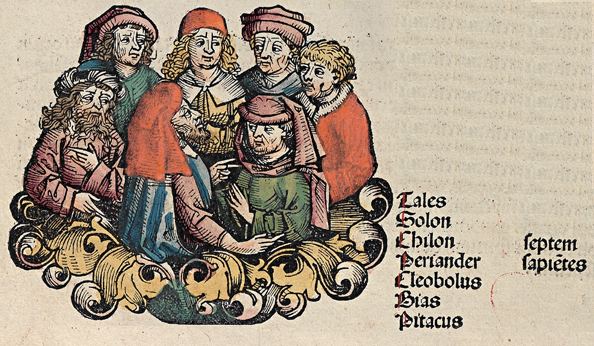
The seven pillars of wisdom...
Although you know what nonsense Klaus, Tăriceanu or Nicușor said, you don't know who the seven wise men of Ancient Greece were. It's okay, as long as we live, we learn...
Cleobulus of Lindos: "Moderation is the best thing" (Greek: πάν μέτρον άριστον, pan metron ariston). By profession.. tyrant of Lindos, Rhodes, c. 600 I.Chr.
Solon of Athens: "Nothing in excess" (Greek: μηδὲν ἄγαν, meiden agan). Solon (c. 638 – 558 BC), reformer, legislator, the one who laid the foundations of democracy in Athens.
Chilo of Sparta: „"Do not wish for the impossible" (Greek: μὴ ἐπιθυμεῖν ἀδυνάτων, mei epithumein adunaton). Chilon – politician, reformer and one of those who laid the foundations of the Spartan utopian society. 6th century BC
Bias from Priene: „"Most people are evil" (Greek: πλεῖστοι ἄνθρωποι κακοί, pleistoi anthropoi kakoi). Bias politician and legislator, 6th century I.Chr.
Thales of Miletus: "Know thyself" (Greek: γνῶθι σεαυτόν, gnothi seauton). Thales (c. 624 – c. 546 BC) philosopher and mathematician. He said it, not the Oracle of Delphi who "plagiarized" it by putting it on the frontispiece.
Pittacus of Mytilene: „"Know your own opportunities/advantages" (Greek: γνῶθι καιρὸν, gnothi kairon). Pittacus (c. 640 – 568 BC) ruled Mytilene (Lesbos) together with Myrsilus. Implementer of popular democracy.
Periander of Corinth: „"Be far from everything" (Greek: Ὅρα τὸ μέλλον, hora to mellon). Periander (fl. 627 BC) tyrant of Corinth in the 7th and 6th centuries BC. The Golden Age of Corinth.
Now you know. But now the question remains: why two tyrants? But why later an Emperor as a pillar of Stoic philosophy?
Here you search for the answer yourself.
PS: The list was made by Socrates. Who couldn't add himself.