A history in full clarification
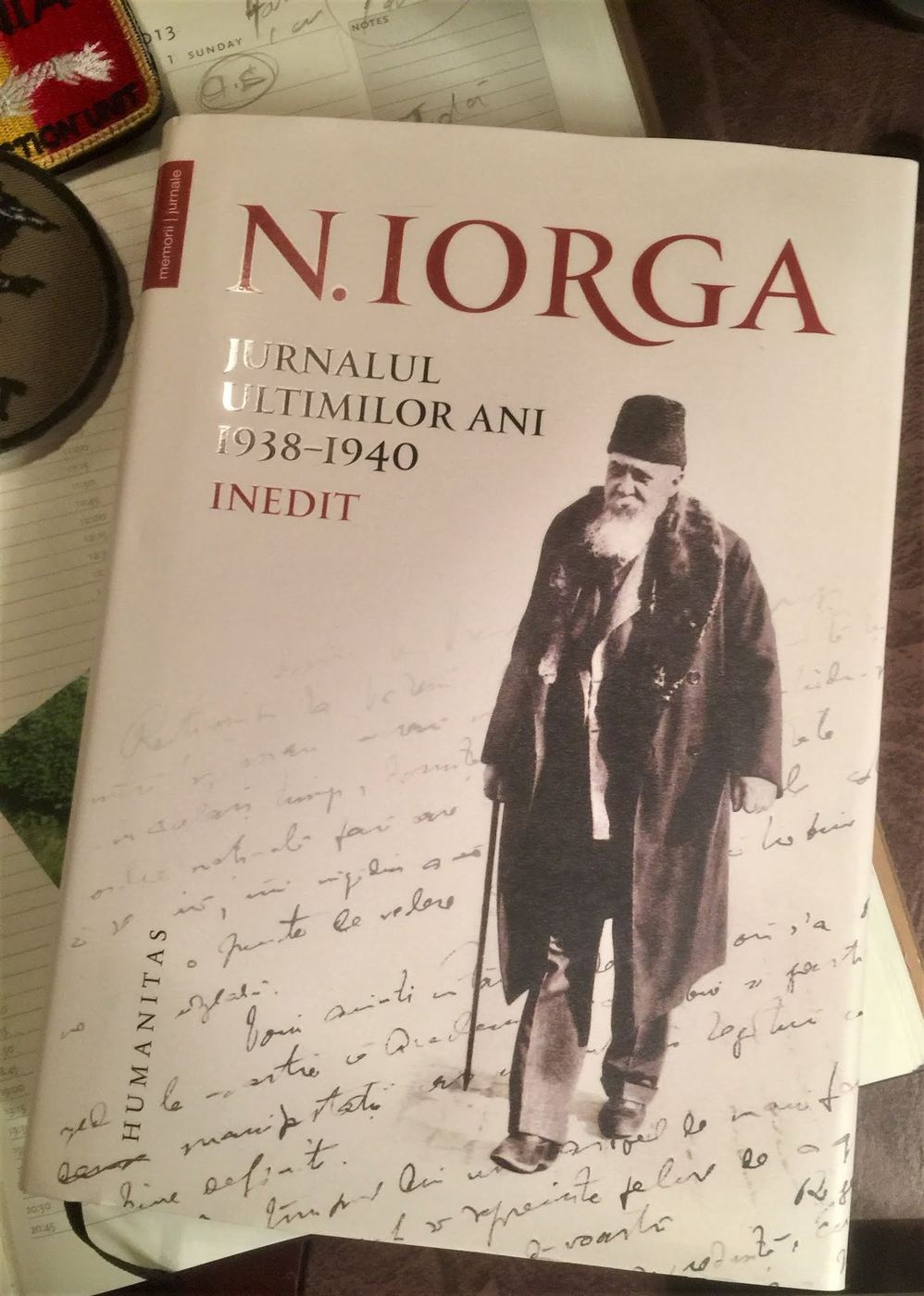
A publishing house (which has been doing a lot of stupid things lately, e.g. "Admiral Horthy, Regent of Hungary" by Catherine Horel) is publishing the volume Nicolae Iorga, Journal of the Last Years, 1938-1940.
After 79 years of silence, we can hear Iorga's voice clarifying an extremely difficult historical situation for Romania. Unpublished texts that were never meant to be published lift a little of the veil that hides that period, the period in which Romania seems to be falling into a bottomless pit.
The loss of Bessarabia and Northern Bukovina, of the Quadrilateral, the incredible political crisis triggered by the Carlist dictatorship, the betrayals of the "historical" parties and the betrayals of Europe, the Soviet attack.
Sad reading and full of teachings, of warnings related to our possible future. Something that was about to happen (and did happen) and what is about to happen now, and can happen. It was hard for me to put it down and, after a 10-hour marathon, I reached the end of a book that enlightened me about that period.
The notes are private, they do not belong to the press and there is a kind of embarrassment in reading them. What Iorga wanted to say publicly, he did in the newspaper he led and in broadcast conferences. The diary is an intimate document. But out of the need to understand the truth, sometimes, privacy can be violated. And this is such a moment. Another argument is that in a personal diary no lies or moderation slip in, but only what the author thinks. The diary is sincere.
We find an Iorga as his contemporaries describe him: arrogant, haughty, self-sufficient, vengeful, holding grudges and doing, almost daily, what today we call "influence trafficking". We find an Iorga fully dedicated to the cause of Romania and the Romanians, to the fight for national and nationalist affirmation, to support Orthodoxy and the national element. We find an Iorga who sacrifices himself for the fate of the country, but only in his own way and as he dictates. Fighting for the cause of culture and dedicating his time to helping others. At the same time as he undermines anything and anyone who opposed him, now or at any time in the past. He does not get bogged down in sarcasm, Iorga attacks clearly, directly and without mercy.
We see Gusti, Giurescu, Scriban, Herseni thus abolished. Armand Călinescu (complicated relationship), Bratieni and... no one escapes Iorga's harshness.
I do not hide the fact that one of my reasons was to clarify the relations between Iorga and Codreanu Zelea. Something does not fit in the descriptions of both those then and, even more so, those now. There is a fracture between them that, although it occurred before 1938, still creates events. One of them being the conviction and then the assassination of the Captain following a complaint by Iorga. And, two years later, the assassination of Iorga by the Iron Guard (personally I do not believe that Horia Sima's Iron Guard, or anything that followed the events of 1938, can be assimilated to the Legion of Archangel Michael; The Legion was assassinated on the orders of Carol II and died in a forest edge. What continued is only a remnant, Nazi, Antonescuian manipulation and proletarian anger).
Although I could only recommend the book, I'm sure few will read it. And then, to raise your level of knowledge or to incite interest, I will publish a few excerpts concerning the Legion, the Captain, and the assassinations.
Let's not forget the deep enmity between the two during this period.
In 1938
„"„ […] MARCH 15 . Armand Călinescu tells me that, as was natural, the guards are very encouraged by the Hitlerite victory ( annexation of Austriai). Codreanu sent a telegram to Hitler, namely through the cipher of Fabricius. He receives the deputies and makes visits. His people announce that soon, like in Moscow, we will be put against the wall.
When he arrives at the Green House, his flag is raised! I demand that he be removed.
But the legionary trade is in liquidation. He had respected the legal formalities. […]”
„[…] MARCH 26 The restaurants where the Codrenists gathered were closed. Some nests were arrested. The crazy people in the group are demanding the „sanctioning” of Călinescu, who is not afraid. […] „
„[…] MARCH 27 Codreanu sends me a series of insults in a car, accusing me of closing his shops (!) and quoting an article I didn't write, along with a circular order from Călinescu that doesn't exist, making me, in your ridiculous phrase, "dishonest" due to a comical lack of intelligence and inability to express myself.
I put the appropriate apostille, that the one who sent me these thoughtless lines should think about the crimes he committed and caused and that only through repentance, no longer gathering dangers for his country, could he atone. I will prosecute him for insult. I will tell Armand Călinescu who had been looking for me in vain all day. The royal commissioner will present the letter, typed on a typewriter with all the inscriptions, to Codreanu to ask him if he recognizes it. He will not do it, it will be published to demonstrate his cowardice. If he does, he will be tried as soon as possible. I showed Călinescu that, under these conditions, arrest is no longer necessary. […]”
„[…] MARCH 29 Colonel Hotineanu to me. He went to Codreanu the next day early in the morning. He found him at Casa Verde, the unkempt and dirty house. He was dressed in German. Without giving him time to think, he showed him the letter. He declared that he recognized it. To be sure that he would send me copies through my son Mircea, through Schina. He wrote out the recognition in the form that was presented to him. Given the trial, he showed that "it suits him". He joked when leaving: "if he comes as kindly as he is, let him come again". Hotineanu told him that the second time it would be like that, but the third time, he could be asked to accompany him.
He also knows old Zelea, "a conceited fool". The son is an inferior. Raised by his father to play this role. He can barely express himself. He also cannot explain the influence he exercises over people like Manoilescu and Nae Ionescu. […]"„
[…] N. Gerogescu to me. The whole city knows about the Ministry chaired by Prezan, who returned from Paris by plane…
We read the news from the Police. The Legionnaires continue to gather in uniforms in one restaurant after another. Titeica (!!) gave them a speech of approval on the occasion of the icon being placed at the Faculty of Science. Where are we going, Lord! […]”
„[…] APRIL 7 After a long absence, Călinescu appears. He tells me that, at the interrogation, Codreanu tried to pass off his letter as a simple response to a newspaper article of mine… […]”
„[…] APRIL 16 In Văleni, my son Mircea asks me to drop the case against Codreanu, who according to the new penal code should be arrested. Since no one from the government has anything left to tell me, I consent.
I am sending this telegram:
„"Colonel Hotineanu,
Military Prosecutor's Office
Bucharest
Convinced by the answers given to the investigation that lawyer Corneliu Z. Codreanu is unaware of his actions, I cancel the request to be tried for the childish letter sent to me.".
APRIL 17 Hotineanu to me. Last night Codreanu was arrested with 150 of his people. The police are keeping the place of his detention secret. I would like to continue the trial, which is on Tuesday.
I show not only my occupations and my very poor health, but also my lack of willingness to take on what the government, which has no connection with me, does not dare to do. Since calls for revolution have been found written by Codreanu, who treats my action as "vile" and presents the elderly as beings with "dry brains", he must be judged for this, the rest being only subsidiary. I give him my explanations in writing in this regard, showing that even after the letter not only I am attacked, but also the government and especially the Minister of the Interior, who ordered the closure of the restaurant. I therefore indicate a postponement and a consultation. He finds these statements "precious".
He also brings a letter from Averescu in which he approves my action and asks to be called as a witness. His first letter was, Hotineanu believes, intercepted by the marshal's entourage. […]”
APRIL 19 My first letter was not read. Codreanu was sentenced to six months in prison.
20 APRILL Armand Călinescu to me. My telegram was not read so as not to influence the judges. He shows me what was found at Codreanu and his people. Among other things, the list of his informants, everywhere, and at the General Staff, with their inscriptions. And military files. A letter in which Codreanu allows money to be taken from Jews, individually. A telegram of congratulations to Hitler on the Anschluss, through the German Legation. A report from Berlin. An address to the Hitlerites so that they don't talk about war, because they are losing their adherents here.
He, Călinescu, is determined to go all the way. […]”
„[…] May 27 From Bucharest to Venice, after Codreanu's conviction. […]”
” […] JUNE 3 Zamfirescu tells me that our situation with the Italians is bad, although the moment was right to impose ourselves. We give in and humble ourselves. It is a long and heavy legacy. However, he was told, despite the articles glorifying the gentle "martyr" Codreanu, that Italy does not understand interfering in the lives of others - but Ciano will talk about influence in the "Danubian and Balkan regions", mentioning only the Yugoslavs - and that, since no one stood up for Codreanu, the man is no longer interesting. […]"„
There are dozens of other annotations by Iorga on Codreanu's conviction. His protest against the conditions in which the legionnaires were held or the ill-treatment meted out to them, the news of the assassination and Iorga's anger against this barbarity.
Unknown to modern historiography (or perhaps unknown until now?) is this withdrawal of Iorga's accusations. In practical terms, Codreanu should have been released immediately. But King Carol II's wishes were different.
Iorga was once again shedding a ray of light on our history and stories from the grave.
Historical truths, sooner or later, come to light.
A book worth reading.