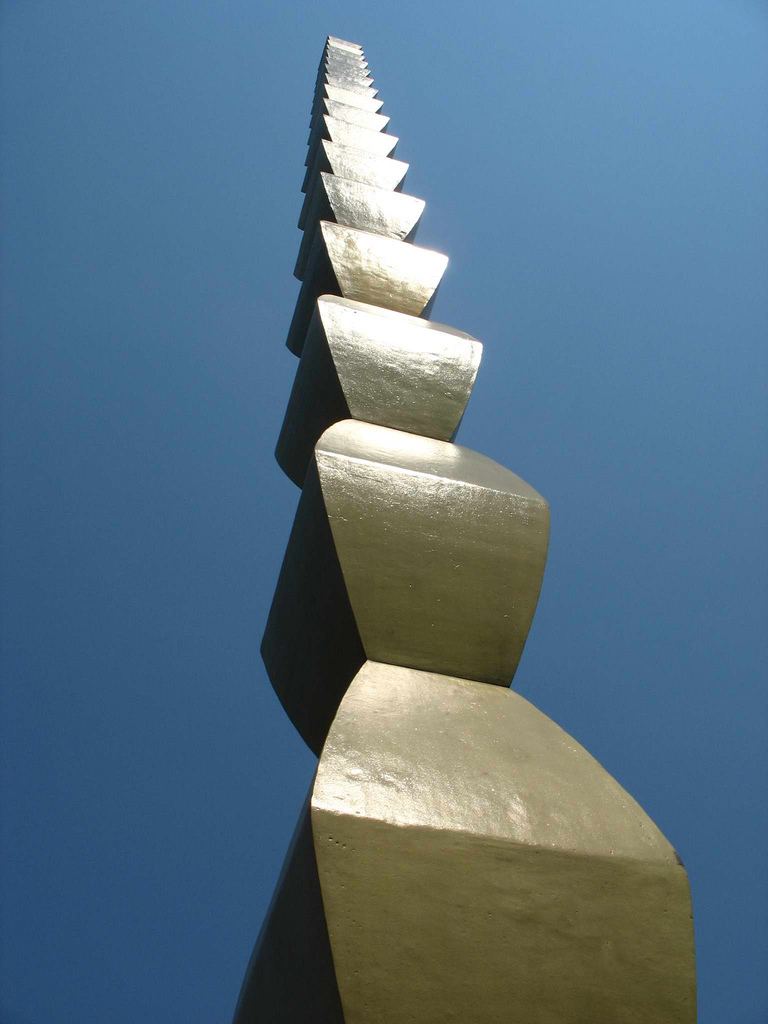
The endless column
always modifies not only its semantics but also its form, through optical effects
strange, depending on the angle at which the viewer sits.
First, you must approach it in the evening, before sunset, coming from the west on The Path of Heroes, so having the sun behind. Then Column
It appears to you illuminated, in all its splendor. It has the color
pale gold, without metallic reflections, in the shade of ripe wheat. As
as you get closer, the rhombohedral modules lose their geometrically cut contours
so that, from a certain angle, the whole thing looks like a giant ear of wheat,
of hallucinatory, dreamlike dimensions. Let us not lose sight of the fact that in
In ancient Greece, at initiation into the Eleusinian Mysteries, the epopt was given
finally showed, as the supreme symbol, an ear of wheat. This also confirmed
reveals the main mystery of life. Wheat is the substance
of life, as it nourishes and sustains our life, not only physically but also
metaphysical. As a metaphysical principle of life, it is the unseen essence of
of all life forms. Then, it is not only the substance of life, but also
the meaning of life, which meaning is fruition through death. In this sense
The symbol was also used in the Gospel. Jesus said that the grain
of wheat that does not die, that is, that which does not sprout, remains alone.
And he who dies (sprouts), bears much fruit.
Then comes the night. Under the dominating light of the moon, Column
becomes a cold, ghostly pillar of fire, a stillness of death, a
sign from the other realm. One side of the modules gives a deceptive light,
and the other is dark, under the shadows, a hidden threat, a
restlessness, an ominous spirit.
*
Let's not forget: The endless column Brancusi's
is, in essence, a funerary monument. A monument dedicated to the heroes
who died in the battles of Jiu, in the late autumn of 1916. Those
who had the mission to defend this bridge fought with unparalleled bravery
They all fell in battle, down to one. This was also
the intention clearly expressed by Brâncuși: to erect a monument to them
funeral. For this purpose, he went to the town hall of Peştişani, a commune of
which also holds his native Hobița, in the summer of 1922. Brâncuși proposed
then to erect a funerary monument to the heroes of Jiu, but
The commune leadership refused. What kind of monument would the artist have proposed?
Did the villagers find the proposal made by the
Brancusi? It is not known. Once again the prophet was not well received in
his homeland.
raising column in Târgu Jiu it was possible
only much later, around 1937-1938, thanks to the tireless efforts
undertaken by Mrs. Arethia Tătărăscu, wife of the Prime Minister
since then of Romania. Gheorghe Tătărăscu was originally from Gorj, had
near Filiași a small estate, where Brâncuși was hosted in the summer
year 1936. Arethia Tătărăscu, through Gorje Women's League
led by her, managed to collect the sum of two million two
hundreds of thousands of lei, money from which the expropriations in the city were made, in order to
ROUNDING The Path of Heroes, and the works at the Church were financed
„"St. Apostles Peter and Paul", part of the Ensemble designed by
to Brancusi. Then in the summer of 1937, before starting work on
The Endless Column, Brancusi travels to Egypt for the first time
*
is a funerary monument. The modules it is made up of,
sixteen in number, are actually pyramid truncated pieces joined together
two. If we look at them as being joined on the large base, as they are
in fact, technically speaking, then we get a rhombohedron.
If we look at them joined together on the small base, we have the suggestion of an hourglass. How
I showed above, shortly before starting work on Column,
Brancusi traveled to Egypt and saw the pyramids for the first time.
The pyramid trunks imagined by Brâncuși during the construction column
are, however, much higher in relation to the base. Consequently, they are
more flexible, more capable of reproducing the essence and idea of flight. As for
As for the Egyptian pyramids, for example, the largest of them had a
height of 138 meters, compared to a base with a side of 227 meters. So
the ratio between height and base would be approximately 1/1.6 in
in favor of the base, this ratio denoting the famous golden ratio
attributed to Pythagoras. Beyond the state of melancholy induced by the theme
ruins, the image of solitude in the desert, the Egyptian pyramid gives us
and the oppressive impression of gigantism that crushes human measure, of
overwhelming massiveness and weight. In Brancusi's case, on the other hand, the trunk of
pyramid of the way column has a large base of 90 cm and
the height is also 90 cm, the small base being 45 cm, that is, half of
the large base and the height, and the total height of the rhombohedron is
1.80 meters, that is, double the large base and the height of each trunk
pyramid that is part of it. If we extend the trunk imaginary
of the Brâncuși pyramid to the top, then we will obtain a pyramid with
the ratio of 2/1 in favor of the height, compared to 1/1.6 in favor of the base,
as in the case of the Egyptian pyramid. The top of the imaginary pyramid of
Brancusi will be found exactly in the center of the rhombohedron on the Column.
The multiple optical effects are given precisely by this finding of some
perfect relationships of proportions that can perfectly express the idea
imponderable ascension to heaven, as this happened for good
once upon a time on the road to Emmaus, the idea of flight towards infinity. And
rhombohedrons column there are a total of 16, that is, the golden number 1.6 multiplied by the sacred decade, also Pythagorean.
If we approach Column louder (or maybe
too strong), looking at it from the sagittal plane, this shows us another facet of
The large bases of the rhombohedra approach each other in such a way that
so that they practically overlap each other, canceling out the very image
rhombo-rhythmic, appearing to us as a simple golden path to the sky,
undulating endlessly, just as, at sunrise from the sea, a
A path of rays and fire spreads out like a shadow on the waves, from the feet
ours to the endless distance of the star of light. We miss
only the belief that we can step on it and that we can walk on water without getting lost
we sink. And when we turn back, to regain our sense
reality, Column she also regains her rhythm
rhombohedral, we see again how each module appears, grows and then
narrows to pass into the next, we see how life throbs from
birth to fulfillment and then to destruction, we see mothers giving birth to us and
As the graves swallow us, we see and feel a living pulsation that repeats itself at
infinite.
And if we remember once again that this is a
funerary monument, we cannot help but think of another possible
model, other than the pyramids of ancient Egypt, which will have stood with
certainty at the base column Brâncuşi. In the village cemetery
The hobbits could be seen then, and can still be seen today,
old wooden crosses crafted in a unique style. The vertical axis of the
The crosses, as well as the horizontal bar, are carved towards the place of
joint in the form of a truncated pyramid, with the small base facing inward,
at the joint. Over time, the wooden cross rots and the horizontal crossbar
falls. Then it remains stuck to the headboard for a while longer
the tomb only the vertical axis of the cross, revealing on top
tall grasses two pyramid trunks joined at the small base, like
(avant la lettre) two half-modules from The endless column.
The fact is so real that it has given rise to fabrications, leading to
to the false and stupid opinion, according to which in certain villages in Gorj,
There would be no crosses placed at men's graves, only carved pillars
with rhombohedral patterns, something like totems, as if we were a
island at the antipodes, and not a country that is part of civilization
Christian. However, whatever the case, it is certain that Brâncuși was able to
since childhood, in the cemetery of the village of Hobiţa, I saw wooden crosses
carved in the manner shown above, that such images have sedimented deeply
in his soul and that the great artist carried them with him, sometimes
consciously sometimes not, for the rest of your life.
On the other hand, if we take a module from Column
in isolation and we look at it from a certain angle, having one of the
edges in the center of the image, then through the natural play of light and
shadows, we will have a very clear image of a cross, a cross with arms
equal, a cross that can be circumscribed in a circle.
We can change the angle from which we look once again Column, we can slowly rotate around it and look at it obliquely, from the edges of the modules back towards the sagittal plane. Then Column
it metamorphoses amazingly, the modules seem to tilt and twist
in a precarious balance, from which only constant movement would
could save them and restore their natural balance. Column ISI
loses its static character and becomes a rotating drill
ceaselessly towards the sky. A drill like the old wood screws of
to primitive oil or grape presses.
Or we can change the angle from which we look at it again,
we can try to look at it in such a way as to mitigate or even eliminate
cancel the effect of the bottom-up perspective, we can try to situate ourselves with
our eye somewhere in the middle column, we can climb
in a tall tree at the edge of the park or, better yet, we can go to
the upper floors of nearby buildings. Then the modules are given to us
they appear in all their weightless suppleness, full of the tension of the surge
and of flying high.
The works at The endless column they lasted a
year. In 1937, at the beginning of November, Brâncuși mounted
the first module. A year later, on October 27, 1938, Brâncuși assisted
gathered at the consecration service ensemble his. The photos
from the event shows him exhausted by the effort of creation, aged, with
completely gray beard, like an icon of the Good God resting in
the seventh day after Genesis.
Brancusi was a good Orthodox Christian all his life and
had a strong and deep connection with the Church. In his youth, as
While he was a student in Craiova and then a student in Bucharest, he was
pew singer at the Madona Dudu Church and, respectively, at the Church
Mavrogheni. He received two hundred lei per year from here, money with which he
maintained at school. A photo taken in Bucharest when he was
age of 22, he is depicted in the vestments of a subdeacon. He
knows that he had a very pleasant tenor voice. Then, when he became famous
and with good financial condition, in 1921, he donated a significant amount
of money for the construction of the new church in his native Hobiţa, having been passed
among the founders.
During the time he worked at ensemble from Targu
Jiu, Brâncuși was always asked by many people about
all the social conditions regarding what exactly he means by
his works. But he did not offer anyone a specific explanation. Instead, he said
patiently, each one individually, to think for himself and find
the significance of these works. But did Brâncuși himself have a
Your own interpretation of them? Maybe so.
Regarding The endless column, before leaving Romania forever, Brâncuși said: „"You don't realize what I'm leaving you here!"”
Nicolae IUGA
https://ro.wikipedia.org/wiki/Nicolae_Iuga