The Inn
Today
It's been 690 years since the Battle of Posada.
How to
came to conflict? In 1324 Basarab I was under the sovereignty of
Carol Robert of Anjou. A year later, the Romanian ruler conquers
Severin, which led to the cooling of relations with the Kingdom of Hungary.
Moreover, from 1327 Basarab refused to pay
vassal tribute. These things led the Hungarian king to
the advice of Dionysius (later Ban of Severin), to undertake a
expedition to reconquer lost territory and punish the
his vassal.
What
next? Charles Robert of Anjou, King of Hungary, with a strong
army, leaves Timișoara to punish Basarab
The founder. As was customary, the Romans burn the storehouses, poison the
wells and famine strikes the Hungarian army.
Army
but the Hungarians advance and conquer the seat of the fortress, the Court of
Argeș. Although Basarab offers peace and a generous tribute :"only you
Return in peace and beware of dangers, for if you come
"From now on, you will not escape them.". Carol Robert
arrogantly replies that Basarab is the shepherd of all his sheep
and that he would drag him out of his den by the beard. Arriving at the Court of
Argeș finds her naked and sets her on fire.
From here it is
returns to Hungary only to be surprised in a fortified valley
(a "posada") where a massacre begins that lasts 3 days.
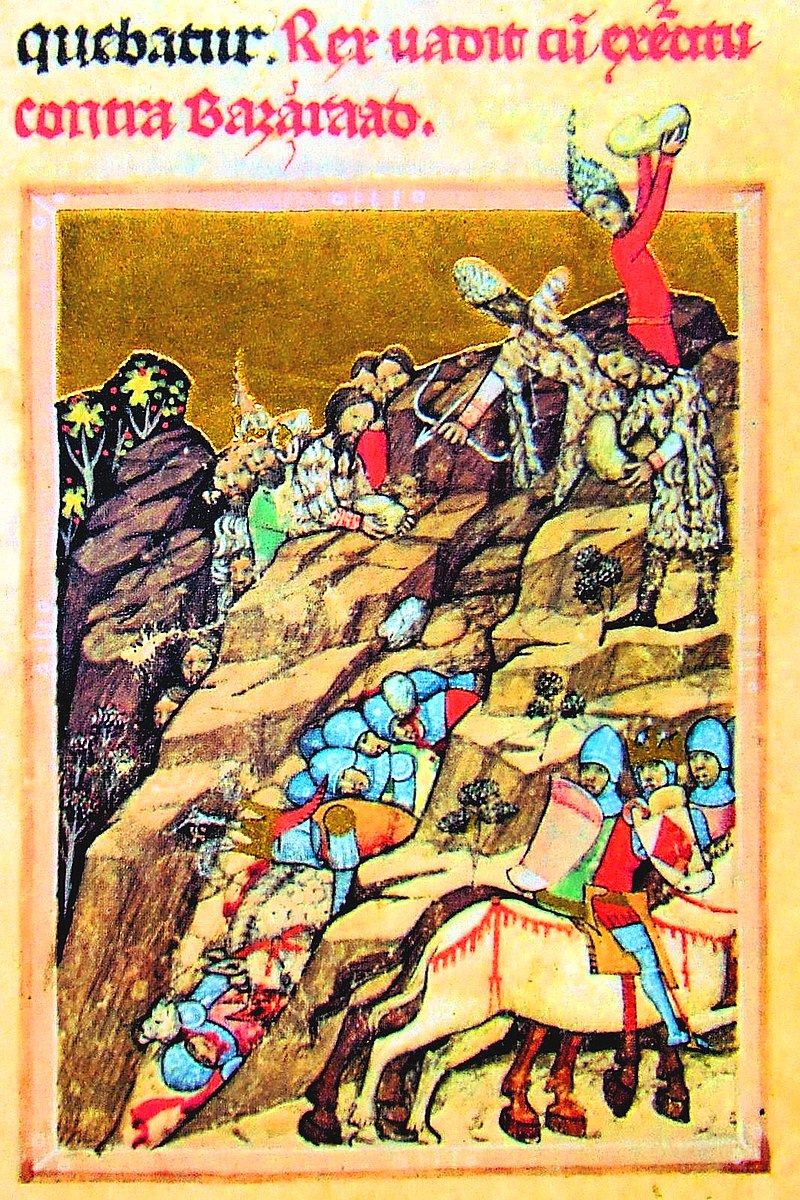
„"Bassarabian"
He came on a path with all his army, and the path was crooked and
both sides with very high ravines, it was enclosed around,
and where the said path was wider, there the Wallachians in more
places had fortified it with ditches dug around it. And the king and
All his people really didn't think of such a thing. The crowd
countless of Wallachians, up on the ravines running from all sides,
threw arrows at the Hungarian army that was at the bottom of the path
road, which however should not have been called a road, but rather a kind of
of a narrow ship, where, because of the crowding, the most
swift horses and soldiers fell in battle, because of the
The steep climb on the way could not be climbed against the Wallachians,
on any of the ravines on either side of the road; nor
could move forward, nor did they have room to run, the trenches being
dug there, but the king's soldiers were completely trapped, like
fish in a net or in a net."”
—Chronicle
painted from Vienna
After
3-day battle, November 9 – 12, 1330, Charles Robert of Anjou
barely escaped, changing his clothes into those of a soldier in order to
not be recognized.
„"They have
fallen young and old, princes and nobles, without any
difference. For this sad event lasted a long time, from
the sixth day of the week, until the second day of the week
future, in which days the chosen soldiers would thus clash with each other
like babies rocking and shaking in a cradle, or like
reeds swaying in the wind. A more terrible murder was committed here,
for the multitude of soldiers, princes and nobles fell, and the number
"They cannot be counted."”
—Chronicle
painted from Vienna
„"Romanians...
They seized a large amount of loot, weapons, expensive clothing,
gold and silver money and many precious vessels"”
—Chronicle
of Johann de Thurocz
location
of the battle has not been established with certainty to this day,
historians opting for places such as: Olt Valley, in Șara
Loviștei at Titești, in the Mehadia area (in the Severin Banat), on
the Rucăr-Bran corridor or the Prahova Valley. A large share in the choice
the location was the return journey, calculated by deduction
logical as being either the safest (respectively the one from Turnu
Severin), or the shortest (the Carpathian passes to Sibiu
or Brașov). Even in the hypothesis of the existence of the armistice, it is not possible
conclude with certainty that the Romanians indeed took the
enemies on the shortest route to Hungary.
Irrelevant.
What is relevant, however, is that today we have something to celebrate.