The superiority of the scribal profession in ancient Egypt
Fortunately, nowadays we have enough sources to get a close idea
the reality of those days, on the importance of the scribe profession during the
Ancient Egypt.
I will not insist on
evidence (it is estimated that only 11% of Egypt's population was literate),
but on the impact of this important scribe on the history of Egypt.
The clearest information
can also be found in the Lansing and Sallier III papyri, both of which are found in
within the British Museum. In fact, I find the papyrus very well analyzed
Sallier but, for various reasons, possible uncertainties, fewer analyses are
made on the margin of the Lansing Papyrus. I would like to divert my attention with
A portion of this document will be quoted below for your information.
supporting the following arguments:
letter instruction written by the royal scribe and chief overseer
of the cattle of Amen-Re, King of the Gods, Nebmare-nakht]
For his disciple, the scribe Wenemdiamun.
[The royal scribe] and the overseer
chief of the cattle of Amen- [Re, King of the Gods. Nebmare-nakht speaks to scribe
Wenemdiamun]. [Approach
this] noble profession … You will find it useful … You will be advanced by
your superiors. You will be sent on missions... Love writing, avoid dancing
; then you will become worthy of being an official. Do not long for the forest of
swamp. Turn your back on throwing stones and running. Day
write with your fingers; recite at night. Make friends with the scroll, with
palette. They are much more pleasant than wine. Writing for the reader
is better than all other professions. He likes it more than
bread and beer, more than clothing and ointment. It is worth more
than an inheritance in Egypt, than a tomb in the west.
Tips for the unwanted student
Young man, how arrogant you are! You don't listen when I speak. Your heart
is denser than a great obelisk, [with
o] height of a hundred cubits, thickness of ten cubits. When it is finished
and ready to load, many work teams are drawing it. This hears
the words of the people; it is loaded onto a barge. Leaving Yebu
is transported, until it comes to rest place in Thebes.
next. He learns to listen to the shepherd; he just misses me
words. Horses brought from the field, forget their mothers. In the yoke, they climb
and descends into all his majesty mission. They become like those who are in
around him, who are in the stable. They do it all because of the fear of a fight.
another way to do it, I would do it for you, so you can listen. You are a
person fit for writing, through whom you have not yet met a woman. Your heart
discern. Your fingers are skillful, your mouth is fit to
recite.
beans; more pleasant than a mother's birth, when her heart knows not
disgust. She is constant in the care of her son; her breast is in
his mouth every day. Happy is the heart of the writer; he is young
every day.
All occupations are bad, except
that of the scribe
Watch with your eyes. Occupations
I am in front of you.
The washerman's day waxes and wanes. All his limbs are weak, [from
cause] of bleaching the neighbors' clothes every day, from washing their linen.
The potter is soaked with earth, like one whose relatives have
dead. His hands, his feet are full of clay, he is like one who
lives in the swamp.
The shoemaker mixes in the vats. His smell is pungent. His hands
His eyes are red with mulberry, like one who is stained with blood. He looks into
his back after the kite, like one whose flesh is exposed.
The watchman prepares garlands and polishes dishes. He spends a night
of toil just like one on whom the Sun shines.
Merchants travel upstream and downstream. They are as
busy, transporting goods from one city to another [city]. They
supplies to him who desires. But the tax collectors take out the gold, the most
precious among metals.
The crews of the ships of each (trade) house receive their
The cargoes. They leave Egypt for Syria, and every man's god is with him.
him. (But) none of them says: "We will see Egypt again!"„
The carpenter who is in the shipyard is transporting lumber and a
stacks. If he gives yesterday's result today, woe to his limbs! The builder
of ships stands behind him for
says bad things.
The worker who is in the field, his is the hardest of all
He spends his day loaded down with his tools, tied to his box
of tools. When he returns home at night, he is loaded with the box of
tools and wood, with his cup and his white stones.
The scribe, he alone, records the result of all. Pay attention to
this!
The peasant's misfortunes
Let me also explain to you the situation of the peasant, that other occupation
hard. [The] flood is coming
and soaks it … he takes care of his tools. By day he sharpens his tools
agricultural; at night he weaves ropes. He even spends his lunch hours in
agricultural work. They equip themselves to go into the field as if they were a
warrior. The dry field lies before him; he goes out to take his chariot with
oxen. When he had been a shepherd for several days, he would gather his cart and return with
her. He makes a place for her on the field. Dawn comes, he goes to start (?) and
He doesn't find it in its place. He spends three days searching; he finds it in
swamp. He finds no skins for them; the jackals have chewed them. He goes out,
clothing in hand, to ask for a cart with oxen for himself.
When he reaches his field, he finds it broken. He spends his time cultivating,
and the serpent follows it. This finishes the seed as it is
thrown to the ground. He does not see a green blade. He plows three furrows with grain
borrowed. His wife went down to the merchants and found nothing for
barter. Now the scribe reaches shore
to record the harvest. The companions are behind him with
sticks, the Nubians with clubs. One says (to him): – Give grain. – No
exists. He is beaten savagely. He is tied up, thrown into the canal, drowned
with his head down. His wife is tied up in his presence. His children are in
chains. His neighbors abandon them and run away. It's all over! No
there are cereals.
one. Pay attention to this! …
[…] Be a scribe and beware of the army! Call and everyone will say:
„"Here I am." You are safe from torment.
Every man seeks to rise. Pay attention to this!”
The role of the scribe appears here as similar to both the modern intellectual,
but also of the modern civil servant, with its advantages, inequalities and some
deviations from social equality, an unknown concept at that time but at
which we can relate to today.
The scribe has roles
diverse, covering almost the entire spectrum of government activity
modern. Scribes I maintain the United Kingdom.
through communications which they do through the administration's own network
Pharaoh, obviously subordinate to him. It therefore functions as a binder of society
and, having the power to write and understand the pharaoh's wish, I become the shadow
of his power. The scribe putting in writing the will of the god-pharaoh, obtained through
extension (a "contamination") of great importance to the rest of society.
The proximity of the pharaoh elevates him, in many cases, above the leaders
military, in some cases even above the religious ones they
substitute in certain cases. Scribes are organized into hierarchical levels
in an extremely complex pyramidal structure, and the competence of a scribe becomes
the requirement of activities that enjoy a certain prestige. Now, in order to
To become a clerk or a priest, knowledge of writing was absolutely necessary.
The scribe is history Kingdom. Which, in
perspective and beliefs on the death and worship of the pharaoh in front of generations
next, has a much greater importance than in other parts of the ancient world
or later in human history. The desire to be preserved in the collective memory
(imaginary) of the pharaoh and the belief in life after death as it is
assumed by the Egyptian civilization gives this exacerbated power
the scribe-historian. The scribe writes, describes
and, in many cases, alters written history. He is the one who, at the request of the priesthood
and the pharaohs, erase important reigns from history. Who controls the writing
history also has great power over the subsequent life of the pharaoh's soul.
The scribe is the tax collector. And the Kingdom
Egyptian, like the rest of the ancient, medieval or modern states, also exists
prosper by collecting taxes. Being those who can write, communicate, and
had access to the archives, the scribes became the financing engine of the Kingdom. The scribes
thus had the power to note, modify and abuse this
quality, a quality that is preserved even in modern days. If in the periods
later there were verification measures, writing and reading being more
accessible, in Ancient Egypt the scribes seem to be the only holders of power. The only
that could have affected their power being the nobility and the priesthood, and they being
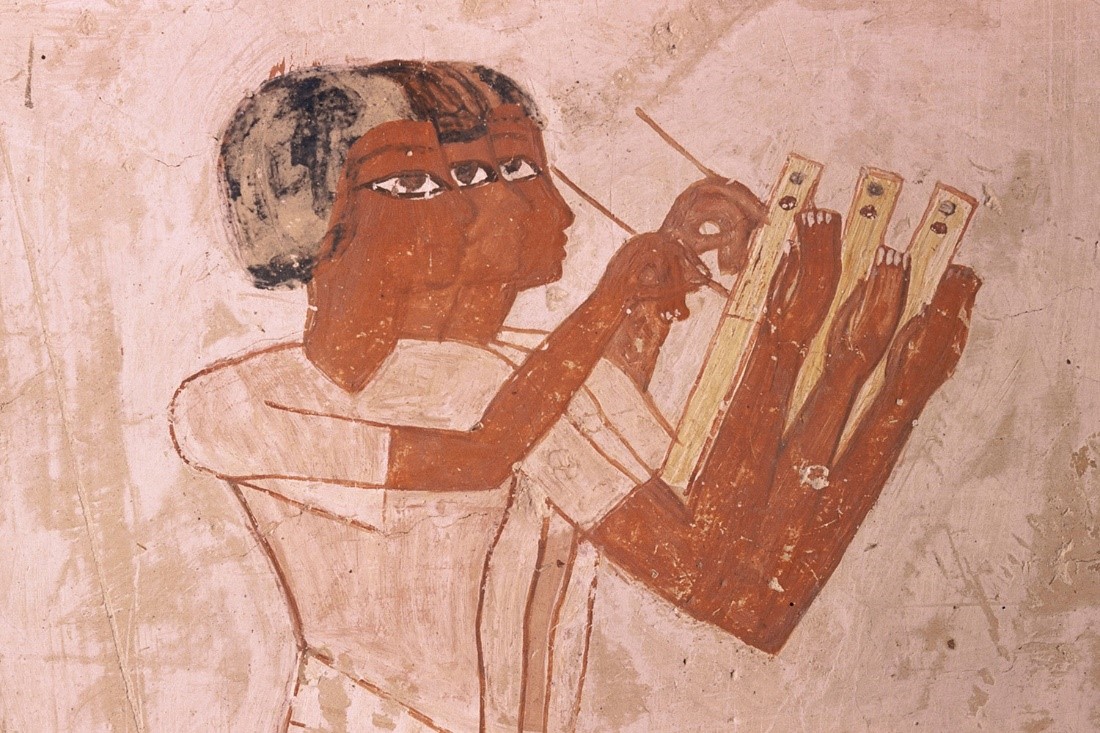
Egyptian scribes appear regularly in funerary frescoes depicting
depicted everyday activities: recording the biennial census of
cattle, measuring fields for tax purposes, checking
deliveries of harvested grain, weighing of precious metals. Old
The Egyptians attached immense significance to the written word. They believed that
the engagement of speech in writing made words real and true, a belief
shared by all Egyptians, literate or not. Those who cannot read
they hired scribes themselves in order to
draw up contracts, letters, inventories and wills. Scribes were intended
thus making the agreements and intentions permanent and binding. When the scribe
reread his work, his client trusted him to recite honestly
the words he had written, trusting that he would not abuse his calling.
The scribe is privileged. Not everyone could become
scribe. It was not easy to become a scribe (a training period of
5-6, up to 12 years old). There is no great competition and therefore personal safety
to be a scribe. The scribe did not need laws (of the "civil servant")
or by agencies (the "National Agency of Civil Servants") to
preserves privileges, they being defended by the difficulty of becoming a scribe
or the inability of the majority to access these positions.
Fragments of ancient hieratic writings, mostly written by student scribes
on limestone flakes called ostraca, suggests that, however humble,
Despite his origins, an educated Egyptian could achieve almost anything. Horemheb
(d.1292 BC) is a good example. Born of middle-class parents,
his training as a scribe led him to a career in the military. During his reign
Akhenaten (1353-1336 BC), Horemheb rose through the military ranks and, in
during the reign of Tutankhamun (1332-1323 BC), he was the commander-in-chief of
Egyptian forces. As a close advisor to the young pharaoh,
Horemheb was called "deputy king in the two lands" and could have been
expected to inherit the throne if the king died childless. He had to
wait a few years, but eventually Horemheb reached the peak of his career
becoming the last king of the 18th dynasty, making his mark by establishing
dramatic reforms in the organization of the army, the judiciary and the
administration in general. The lasting success of these changes was due to
much to his education as a scribe. The trainee scribes were led to believe
that if they stuck to their lessons and followed their tutors' instructions, their careers would
could be devastating.
The scribe has an important role but also a job EASY. This claim is supported by the Lansing Papyrus (
(the reason for quoting it above). If we can look at/read this papyrus
from an admiring point of view regarding his role, he can be
also read from the point of view of the undisguised arrogance of this caste.
Neither the military life, nor the small craftsman's, nor the farmer's or
The shoemaker's work is not valued. It is undervalued
in comparison with the advantages of the scribe's life. It is completely lacking
from these texts (not only in the Lansing papyrus) an empathy with the rest of the classes
social but also a lack of valorization of these classes without whose existence and
work, the Kingdom would have ceased to exist. And here we can draw a parallel
painful contrast between the ancient scribe and the modern civil servant, both manifesting the same
attitude of superiority supported only by formal and generated power
the functioning of an autocratic (distorted-democratic) system.
But education was not within everyone's reach. Government settlements and
major temples supported schools, where boys began training at six or
seven years, sometimes earlier. At these boarding schools, known as
„"stables", family or household servants delivered daily rations of
food and drink to students for several years, during which time the student does not
contributed to the family income. Boys from poorer families could not
hoped to be educated only with the support of a wealthier relative or patron or
through apprenticeship to an older scribe, perhaps the local official or
the land agent, who would teach them the basics of the craft
the scribe.
The text known as Satire
crafts dates back to the Middle Kingdom, the Golden Age of literature
Egyptian, between 2025 and 1700 BC. It belongs to a genus known as
„"Wisdom texts", alleged collections of people's experiences
learned and influential that must be shared with future generations as
advice on behavior, deportation, and career advancement. In the era
Ramesside (1300-1075 BC), the Satire of the Trade was one of the most
frequently copied by student scholars. Compare the work of a scribe with that of a
other trades or crafts, in an attempt to convince the student that education will
will do better than anyone else. The introduction, supposedly written by
a father to his son, reads:
I've seen a lot of beatings - put your heart on it
books! I watched those recruited for work – there is nothing better than
books! [To be a scribe] is the greatest of all callings, there is no
one like this in the whole country.
Several didactic texts extol the benefits of education with the profession of
magistrate promoted as final achievement.
The scribe directs the work of the people. For
he has no taxes because he pays his tribute in writing... Put the writing
in your heart so that you can protect yourself from any kind of hard work and become
a respected magistrate.
The student scribe was constantly urged to be studious:
Don't stay idle or get lost
time. Don't let yourself be pleased, that will be your ruin. Write with your hand, read with your mouth
and seeks advice from the best. A scribe skilled in his calling, a
master of education, he is very lucky. Persevere... don't waste a moment
in idleness or you will be crushed. A boy's ear is on the back; he only hears
when he is beaten. Take these words to heart for your own good.
The badge of trade was the scribe with his palette, usually a narrow rectangle
wooden pen with two or more ink wells and a slot for
holding pens. The palette, along with a tubular container for pen stems
reeds used as pens and a drawstring bag containing other accessories of the
scribe, formed the hieroglyphic sign for a scribe and his activities. A
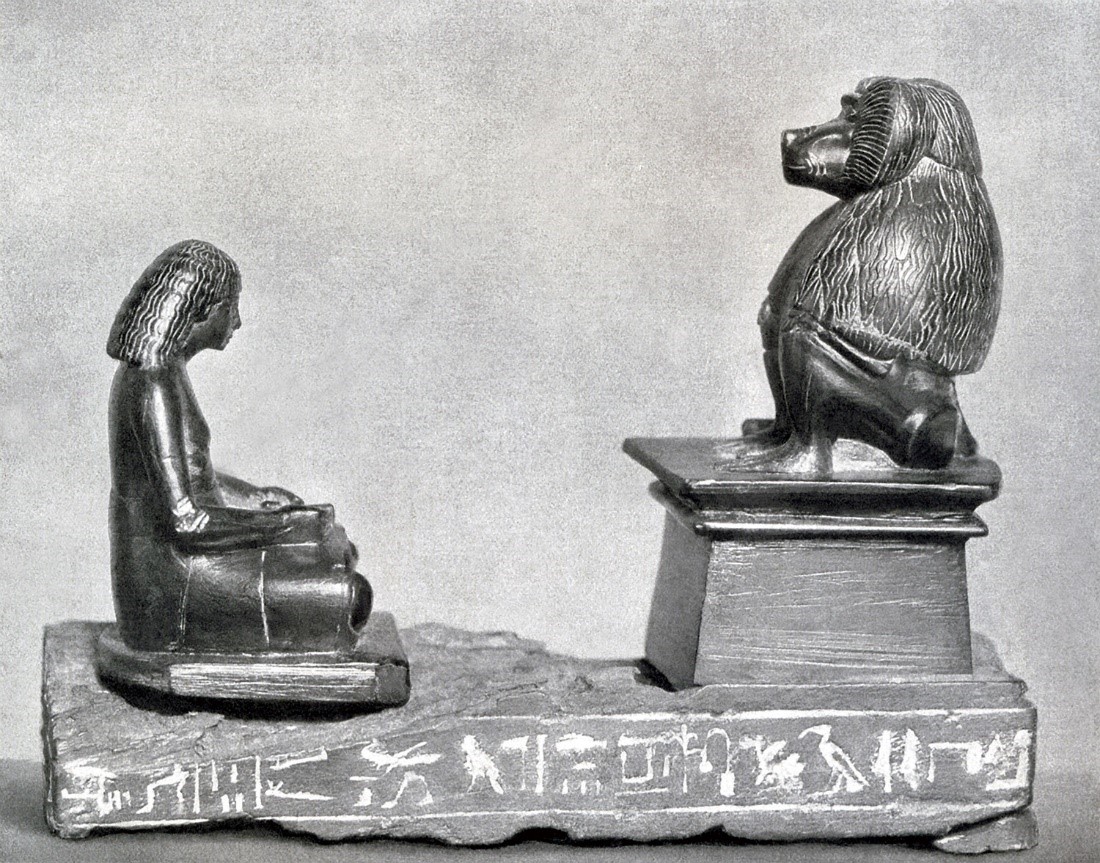
invocation prayer to Thoth, the patron deity of scribes and
the inventor of writing, was used as instruction for students
scholars:
Come to me, Thoth, oh noble ibis... Come
to me and give me advice to make me skillful in your calling. He who
masters is considered fit to hold positions... Fate and luck are found
next to you.
The ink was made from finely ground pigment mixed with a light gum.
and stored in small tablets. By chewing the end of a fresh reed, one gathers
the fibers to form a brush pen, which is immersed in a vessel with
water, traditionally a turtle, before being spun over
the dry ink block to take on the color. When the pen became
tattered or clogged with ink, the scribe will cut off the end and make
the next writing section. The writing surfaces included limestone flakes,
whitewashed boards and rolls of papyrus or leather, the surfaces of which would
could be smoothed with a rounded pebble or a smooth ivory object
special. Errors were wiped off with a damp cloth or scraped off with a piece of
tiles. The water bowl, spare ink pads, erasers and a knife
for cutting and sharpening pens were kept in the scribe's bag.
The scribe's education begins
with the elementary principles of the hieratic script. The lowest scholars,
who have only trained for five or six years, have probably only learned
the rudiments of hieroglyphic script. The students were given documents
copies and excerpts from popular texts to copy, to practice
hieratic writing on basic format letters, reports and contracts,
while absorbing the good advice contained in the texts. Some works
significant Egyptian literary works survive almost exclusively from copies of
students.
A schoolchildren's "dictionary" in hieroglyphs, with their hieratic equivalents,
shows that a knowledge of more than 450 signs was necessary for
daily writing. Lessons in record keeping, recording and
labeling allowed any half-competent scribe to accomplish the task
most essential of all scribal functions: drafting and updating
lists. For professions such as government official, priest or
lawyer, a scribe trained for a few more years, increasing his vocabulary to
probably a thousand or more characters. Those with the best writing skills
hand or drawing could follow the craft of creating beautifully illustrated copies of
funerary texts, commonly called book
of the dead. Others might become draftsmen, artists, or architects.
Doctors compiled their own collections of prescriptions for medicines, treatments
and associated incantations, many copied from texts found in House of Life, the temple library. The lawyers had to be familiar with
with the corpus of civil and religious laws and precedents found in the files
official records, which were administered by archivists. The bureaucratic society of
Egypt depended on the skills of an army of scholars of all ranks,
to the clerk to the tax assessor.
In another key, the scribe is Intellectuals
modern. Demonstrates an understanding of Kingdom history, has a clear understanding
of its functioning and, by the nature of the job, is strongly connected to changes in
and the desires of the pharaoh. It is in the midst of events both in the territory (
through field activities, agricultural, taxation, military, etc.), as well as in
the palaces of the pharaohs and the temples of the priests where policies are developed
kingdom.
The scribe has the means and
time to understand beauty. Poetry, literature, mysticism, all art
hieratic concerns him not only in terms of understanding and transmission but, above all, we find him
and as a generator of culture and knowledge.
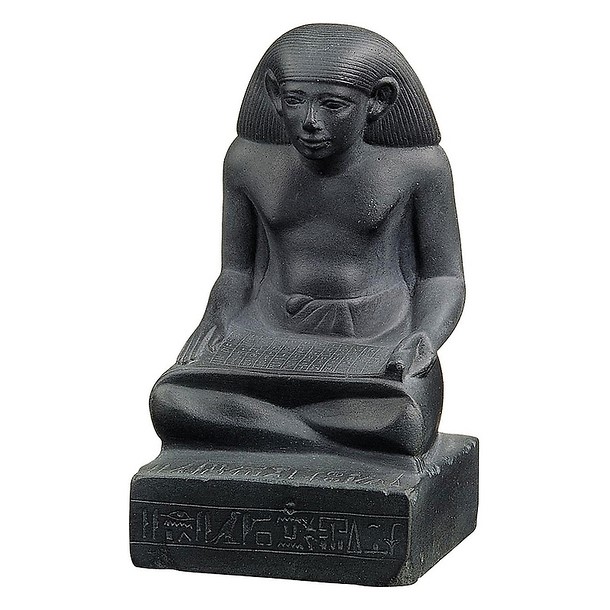
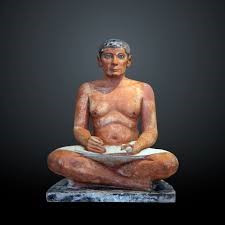
The scribe SUBJECT but it is present. We see it, in
the sculptures and frescoes found, kneeling. Kneeling but present. Present,
but not insignificant. Small, but not tiny. The scribe is seen, and to be seen means
to exist. To exist means that you will exist after passing into the afterlife.
then.
Understanding the scribe
Egyptian is one of our keys to understanding Ancient Egypt. From a
exhaustive perspective we can intrinsically understand Egypt by correctly understanding the institution
scribes.