The art of the elites in the Far East
The art of the elites in the Far East
by Eliza M.
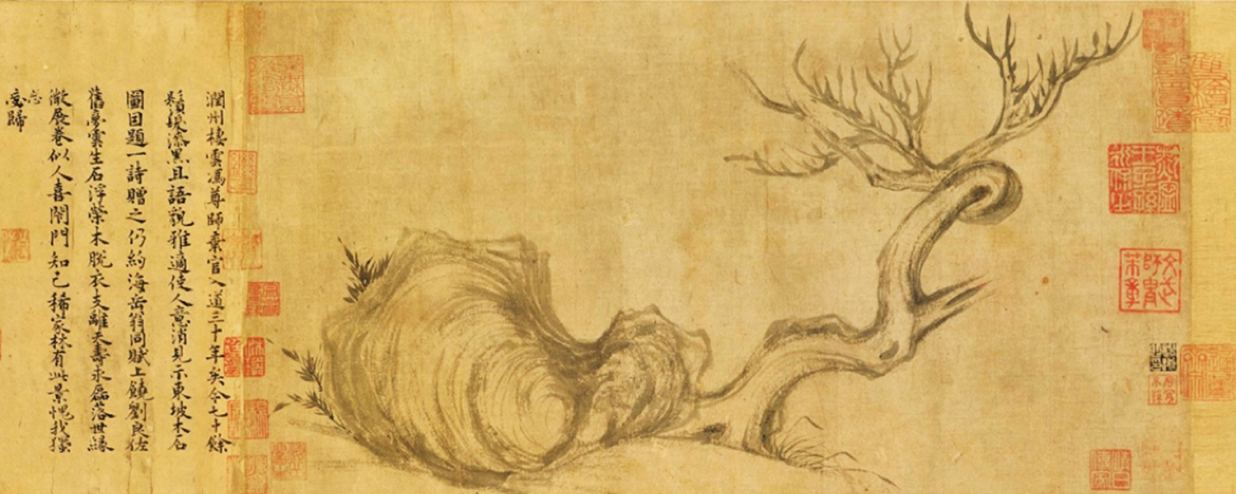
Su Shi (1037-1101) – Trees and Rocks
; ink on paper, 27.2 x 543 cm.
In
the work "Trees and Rocks", which depicts a withered tree next to a rock
unusual shape – complemented by calligraphy, we notice the character less
technically, but much more, the moral character of Su Shi is deciphered,
the refinement with which he sketches his internal state, rather than the "external state" of
landscape.
Su Shi was a member of the intellectual elite
Chinese from the Song Dynasty
(960-1279). The painting belongs to the Song Dynasty period (960-1279) which was a
a turning point in Chinese history – a period that witnessed an explosion of
population, to significant increases in the capacity and economic power of the
empire and the rise of education. During the Song dynasty,
the government's interest was to recruit scholar-officials through the system of
exams, which also incorporate the artistic elements of poetry and, increasingly,
moreover, alongside calligraphy, painting becomes central to the profile
This is seen in the unparalleled refinement in the arts in
this period. Su Shi was a respected figure among official scholars
at court. However, there were tensions between rival political groups of
at the imperial court. Su Shi is found on the conservative side, in terms of
Sima Guang's cultural view of the government. They focused on
entirely on raising the moral level, and the qualifications for leadership have
were conceived entirely in cultural terms. The rival group was
focused on technical knowledge, which could be needed to encourage and support
the development of Song society, in terms of economic growth,
building infrastructure and maintaining a capable military defense. He
articulated a vision of "cultural Confucianism", with the emphasis on the connection
between governance and mastery of China's cultural tradition. Concerns
main writers for the arts,
the study of calligraphy and painting, poetry, was considered a path to
the cultivation of the moral self. In the landscapes painted in ink they revealed their spirit
They lived by Confucian principles and this is seen in the art they produced.
by the imperial elites.
lines
curves through which Su Shi describes his soul wave, the growth and decline of feelings,
The modesty with which the stump stops growing gives harmony to the composition and
a harmonious struggle of emotions, which ultimately leads to a commitment to survival
in justice and fairness.
movement
The rocks plead for loyalty to the law of nature. They spin in circles
and self-discipline through will, they remain loyal to life-giving principles.
Resistance
nature is rendered with brushstrokes, but with a grace, so that at
in the end we only see a balanced and harmonious composition, unshakably stable,
a promise of endurance and full of hope.
In
In his painting, Su Shi reveals himself to us. It's as if he's on the couch
and describes with the brush the undulations of the soul, communicates to us calligraphically and
plastic: the virtues, strength, sensitivity and strength in his condition as a writer
and man.
Picture
continues, both on paper and in time, with the poems of Liu Lianzuo, Mi
Fu, Yu Xilu and Guo Chang.
Even
if the verses show us a distance of these writers from the imperial court,
they confirm to us the steadfastness of principles: "see a meaning in Dao and virtue" "„
the rock rises", "I ask for a blessing". Poverty and needs, austerity are clearly
painted and calligraphed with joy: „I don't have my clothes.
renewed"” ,
„"What a blessing to find this company!".
Shi paints his inner life and house, and his literary friends decorate it.
in operatic verses.
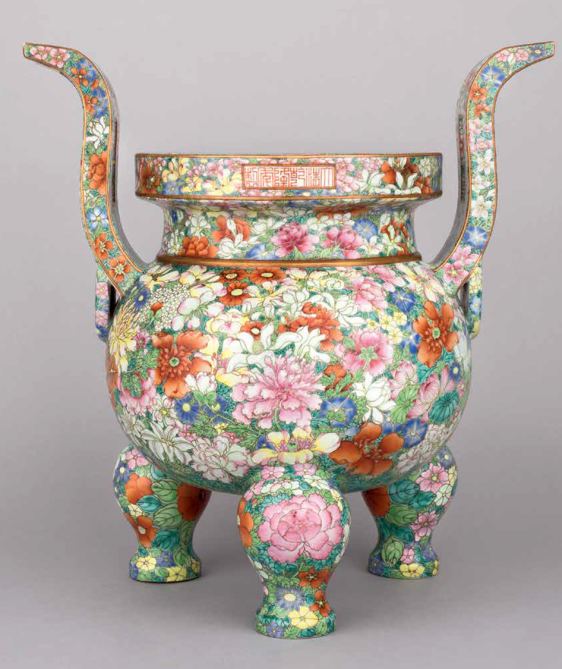
Porcelain vessel for burning essences
fragrant, pink family, decorated in the style of 1000 flowers, China, era
Emperor Qianlong
The models
Millefleurs first appear on porcelains made during the reign
Emperor Yongzheng, but they seem to have reached a peak of quality during the
Qianlong.
king
Qianlong loved the arts, and during his reign the arts "flourished." He
he painted, did calligraphy, wrote poems and thousands of essays.
PUSHED
with his unique artistic views and aesthetic taste, Emperor Qianlong had
used imperial status to direct and redefine the efforts of artists
and the artisans who serve at court. A
sponsored cataloging collections
objects of art and copying all Chinese writings in its heritage
by marking, stamping and inscribing the works of art he inherited
.
king
Qianlong sought to attract the world's attention and admiration by emphasizing the grandeur
empire. Exchange with Western nations and states on the Chinese periphery
led to an influx of foreign elements into the court workshops, but it also brought
with the pink that entered China late. The presence of pink marks the vessel in
pink family series. The pink color is obtained from an extract
of gold.
vessel
porcelain is part of an altar set (Wugong) which was composed of: two vases, two candlesticks
and a vessel for burning fragrant essences.
vessel
It has three legs, with curved vertical handles, with finely executed flower decoration,
which in Chinese tradition symbolizes prosperity. To pay homage to China,
the land of flowers, the flowers all bloom in the season of the vase. Technical details
and the gradients obtained, the outline, the whole decoration is the work of the painters
professionals from the imperial court.
Being an altar piece, the floral motif is not common for these
vessels. Being so impressive, both aesthetically and technically, the reason for a thousand
flowers also seem to impress the elites who saw beauty in simple lines,
because the porcelain preferred by the imperial elites was similar to the motif
paintings. These vases with a thousand flowers, abound in color, in technique, in thousands
of details, advertising wealth and exclusivity. Countless
burnings for the flowers to bloom in colors and now we "burn" when we
we look.
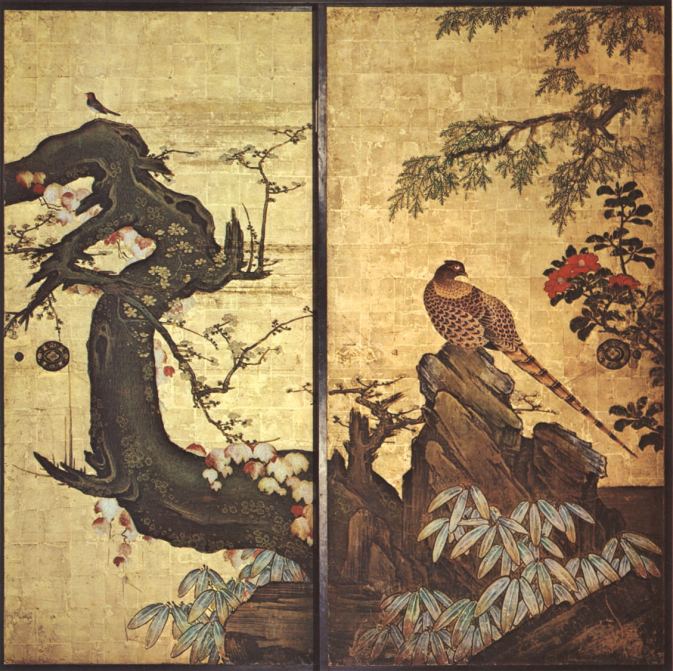
Plum and pheasant, decorative panel, Kano
Sanraku or Kano Sansetsu, Japan, c.
XVII
Bye
these panels we notice how the opaque painting "shine" due to the background
gilded. Everything contrasts in perfect harmony. The old trunk catches life,
blossoms, the branches look to the left, and the peacock to the right, the outlines
clearly delimits each object, but continues with the next one without being able to
make the connection, like in a dream, you can identify each object, but you can't
to establish the thread of the story. As in a realistic, but abstract landscape, as
in an abstract, but realistic painting.
On
Between the two panels lies an old but blossoming tree. The painting gives hope,
the birds, the flowers convince us of a new life. The artist emphasized the tension
through short, twisted branches in dynamic movements in contrast to the hollow trunk. The plum
can be compared to strong principles, to lofty ideals. The branches
The tree's leaves are represented in the tonal variation of black. The plum blossoms are
rendered with the help of red and white spots that intertwine creating
spontaneous gradients. Spring is sung by a bird that sits high, for
so that its song may be heard. On the right panel sits a pheasant with fine plumage,
outlined by short, quick strokes with individual lines. Like the wise old man,
The peacock watches with compassion and love.
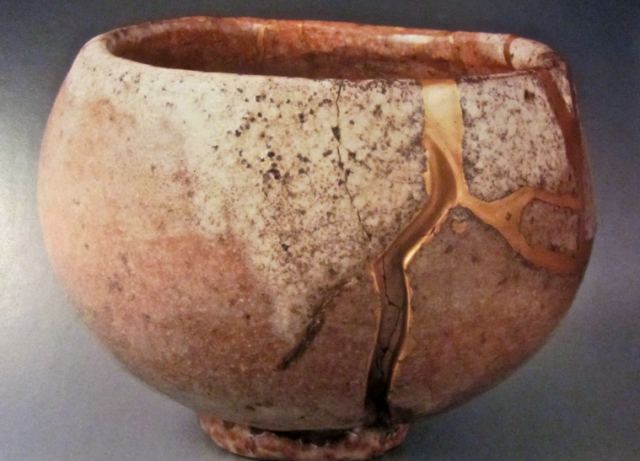
bowl
red raku, known as Seppo. It belonged to the master
Honami Koetsu (1558-1637). It was repaired, after an accident, with gold solder
(kintsugi).
It is
a ceremonial tea bowl. . Tea bowls were first produced in
Kyoto by the Raku family (16th century).
Honami Koetsu studied under the Raku family and became
considered a master. In Japanese pottery culture, raku ware holds a
unique place due to the techniques by which they are made, hand-shaped, without
the potter's wheel. The shape given to each bowl, the craftsmanship through which the potter leaves his
„"imprint"; each bowl receives a part of the craftsman's philosophical experience,
but also from his philosophy of life. The uniqueness through which nature reveals itself in
every thread, leaf, river and mountain reveals its state of being, and the potter borrows
from nature, the diversity in each individuality. He lets it be seen
the present in his hands, does not modify it, does not bring it to perfection, but leaves it
to progress at his own pace. The bowl changes its shape through modeling, without knowing
exactly where you want to go, what is the right form, it emerges, it is discovered.
The bowl reflected its beauty in the potter's hands, the potter reflected his
sensitivity through craftsmanship in the bowl. The philosophy of modeling raku bowls is remarkable,
in the sense that you can see the uneven bubbles and countless asperities, given by the process
of rapid combustion, on the belly of the vessel. The lip of the vessel has several raised areas
given by the spatula, but slightly rounded.
vessel
is repaired using the Kintsugi method, we notice the gold flowing like a branch or
a river that divides. The uniqueness of the bowl continues in time, becomes and remains
the same. Each process takes it from imperfection to another imperfection and
through this he gained the perfection given by uniqueness. Replacing uniqueness with
identity or adding identity, to uniqueness, we could say that Koetsu's bowl It resembles the ship of Theseus. Except that the bowl is not
it is just a mental process, it is alive, it transforms every day and
in this way he continues his process towards perfection through imperfection.